.
✅ FREE QUIZ: Discover Your Mindset Archetype: 3 Strengths, 3 Blockers, and a personalized 7-Day Growth Plan
Podcast version
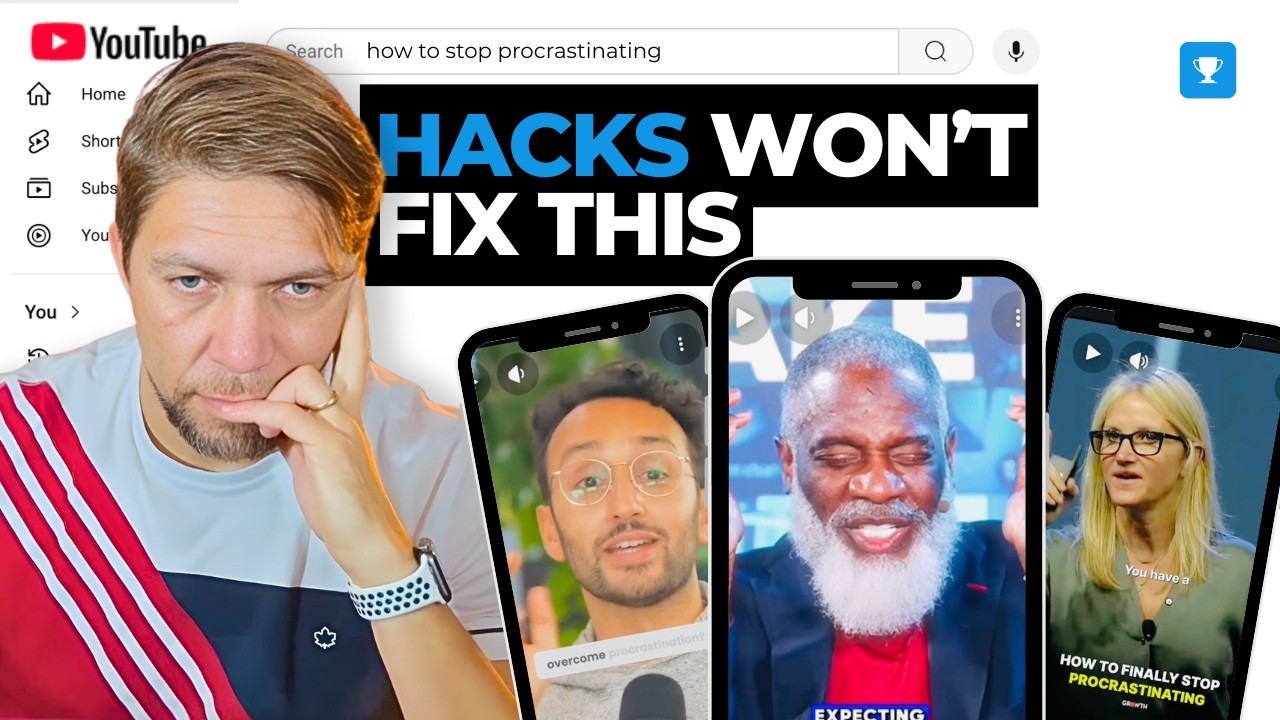
Search how to stop procrastinating and you’ll get hacks. Take the next step.
- Reframe the thought.
- Break the habit loop.
The question is whether it reaches the layer that actually decides if you move.
When I lined up the most popular takes side by side, a pattern showed up. Each one gives you a tool. Very few ask who is holding it.
How to Stop Procrastinating by Taking the “Next Step”
One of the most cited answers to how to stop procrastinating is simple:
- “Ask yourself, what’s the next action step?”
Instead of staring at the whole project, zoom in. Reduce friction. Move. That works. It creates momentum.
But why does it carry you on some days and fall flat on others?
If there’s no internal reason to move, the next step feels optional. Discipline turns into negotiation. Maybe the real issue sits one layer deeper.
Discipline has always followed something.
A philosophy gives you a destination. A destination gives you a reason.
When you’re clear about who you’re trying to become, movement starts to feel aligned instead of forced.
Antonio Damasio argued that:
- “We are feeling machines that think.”
Emotion sits underneath decision. If that’s true, then willpower alone won’t solve how to stop procrastinating. Emotion still decides whether action feels worth it.
When the Future Freezes You
Another popular explanation says procrastination is anxiety. The solution offered is to swap the mental movie and imagine success.
That opens a bigger question.
Humans can simulate the future. That ability lets us plan. It also lets us suffer before anything has happened.
Alfred North Whitehead wrote that we think so our thoughts can die instead of us.
We run scenarios. Some of those scenarios end in collapse.
The ancient myth of Medusa captured this long before psychology did. You look at something terrifying and you freeze.
Imagination fuels ambition. It can also fuel avoidance.
So what shifts?
You can train your response. Instead of waiting for a better mood, you move an inch.
On the days when the future feels heavy, you act anyway. Over time, you teach your nervous system a new pattern: emotion rises, action follows.
This doesn’t erase fear. It changes the sequence.
A simple question helps here:
- “If this were the second time you were living today, what would you change?”
That question moves attention from mood to identity. It’s less about productivity and more about alignment.
Who are you practicing being?
When you ask how to stop procrastinating, you’re often searching for tactics. The deeper tension might be identity.
Habit Loops, Stories, and Self-Worth
A third perspective reframes procrastination as a habit.
- A trigger.
- A pattern.
- A reward.
Stress shows up, you avoid the task, you feel relief. If you start for five minutes, momentum builds.
That framework gives you leverage. It explains repetition.
But habits attach to stories.
Everything you repeatedly reinforce becomes familiar. Sometimes what you’ve reinforced isn’t productivity.
It’s a script:
- You’re behind.
- You’re not good enough.
- You’ll probably fail.
Those ideas carry emotion. Often that emotion belongs to a younger version of you. Years later, that story still runs.
Carol Dweck’s growth mindset research introduces a small but powerful shift.
- “Not good” becomes “not good yet.”
The state you’re in now is a stage, not a permanent identity.
When someone points out what you can’t do, you can resist it.
You can also tell yourself they might be temporarily correct. Temporary leaves space for movement.
In that space, how to stop procrastinating becomes less about fixing a flaw and more about training a response.
The Layer Beneath the Hacks
Across these perspectives, a structure emerges:
- Take the next action step.
- Reframe the mental movie.
- Break the habit loop.
Each one helps. None of them decide who you are becoming.
If you keep renegotiating your identity, every tactic feels fragile. If your actions are anchored to a chosen direction, the same tactics feel steady.
So when you search how to stop procrastinating, you can collect another tool. Or you can ask a different question:
Who am I practicing becoming when I sit down to work?
The internet offers answers. The deeper work feels more like an investigation into identity.
That investigation changes how you move long before it changes your to-do list.