…
Why most businesses fail comes down to one pattern: they build something the market never asked for, then run out of room to fix it.
The businesses that survive are the ones that test and adjust before the money runs out.
Most people can’t remember their first win. But everyone remembers their first humiliation.
You share something you cared about, and the world doesn’t just reject the thing.
Look at your own devices for a second. The drafts folder, the notes app, the projects that never shipped. Those aren’t just to-do lists.
They’re graveyards.

Not because the ideas were bad, but because finishing them means facing the world again, and maybe getting scarred again.
So the work sits there, safe and unseen, which feels like protection.
It’s the thing keeping you broke.
What is the real reason most businesses fail?
Here’s the uncomfortable number.
According to the U.S. Bureau of Labor Statistics, about one in five new businesses fail in their first year, and close to half are gone within five years.
Ten years in, roughly two-thirds have closed.
Those are the odds every solopreneur is quoting when they say the drawer feels safer than the launch.
But the survival rate isn’t the interesting part. The interesting part is the cause.
When CB Insights read through more than a hundred startup post-mortems, the top reason for failure wasn’t money or team.
It was no market need, at 42%.
The founders built something nobody wanted badly enough to pay for.
If the top reason businesses fail is no market need, why do we keep guessing at need instead of testing for it?
That’s the question underneath the statistic.
The reason most businesses fail is not a mystery of bad ideas. It’s a failure of exposure.
No market need is information that exists before you build, not after.
The market could have told you, if you had asked it early and often instead of perfecting in private.
Why do solopreneurs bury their best business ideas?
So why do we keep the work hidden when hiding is what starves it?
The stuff you keep in the drawer isn’t hidden because it’s unfinished.
It’s hidden because shipping it means exposure, and exposure is where the fear lives.
What you’re known for becomes your personal brand, and if the work fails, you feel like you fail with it.
Think about this for a second.
A solopreneur has no team to hide behind and no manager to sign off on the risk.
When you put something out, it has your name on it and nobody else’s.
So the drawer starts to feel less like procrastination and more like self-defense.
What if the drawer isn’t protecting the work, but starving it of the one thing it needs?
The problem is that a hidden idea can’t earn anything.
It can’t get feedback, it can’t get better, and it can’t get bought.
An idea nobody has seen is worth exactly nothing, no matter how good it is in your head.
That’s the trap sitting underneath every folder full of half-finished projects, and it’s the same trap the failure data describes from the outside.
What does rejection actually cost a solopreneur?
Ryan Holiday has a line about this worth sitting with.
In Ego Is the Enemy, he argues that the real failure isn’t getting rejected.
The real failure is abandoning your principles and killing the work you love because you can’t stand to part with it.
His point lands hard for anyone building alone: if your reputation can’t absorb a few blows, it wasn’t worth much to begin with.
So the cost of rejection feels huge, but the cost of hiding is worse.
Hiding costs you every version of the work that would have gotten better through contact with real people. It costs you the proof you can only get out in the open.
Isn’t it strange that we treat the safe option as the free one?
Every idea you protect is an idea you’ve decided not to improve.
And the solopreneur who never exposes anything never finds out which of their ideas could have paid.
The scar you’re avoiding is also the tuition, and the businesses that skip it show up in that first-year failure column.
What if marketing is just testing your failed ideas?
The only way to stop carrying these ideas around in your head is to let the world judge them.
That word, marketing, sounds like it belongs to big companies with ad budgets and sales teams.
It doesn’t.
Marketing is a fancy word for testing.
That’s the whole thing.
Marketing your ideas means pushing them out to see what sticks, saying “here, try this, tell me what you think,” and then watching what comes back.
It’s an experiment you run in public, and it’s the direct answer to the no-market-need problem that sinks most businesses.
So if marketing is testing, what is a rejection, really worth to you?
A rejection is a result.
Every test is a door, and when it doesn’t open, you’ve learned where not to go.
The failed business idea isn’t a dead end.
It’s one data point in a much longer search, and the search is the actual work of making money as a solopreneur.
The Law of a Thousand Doors?
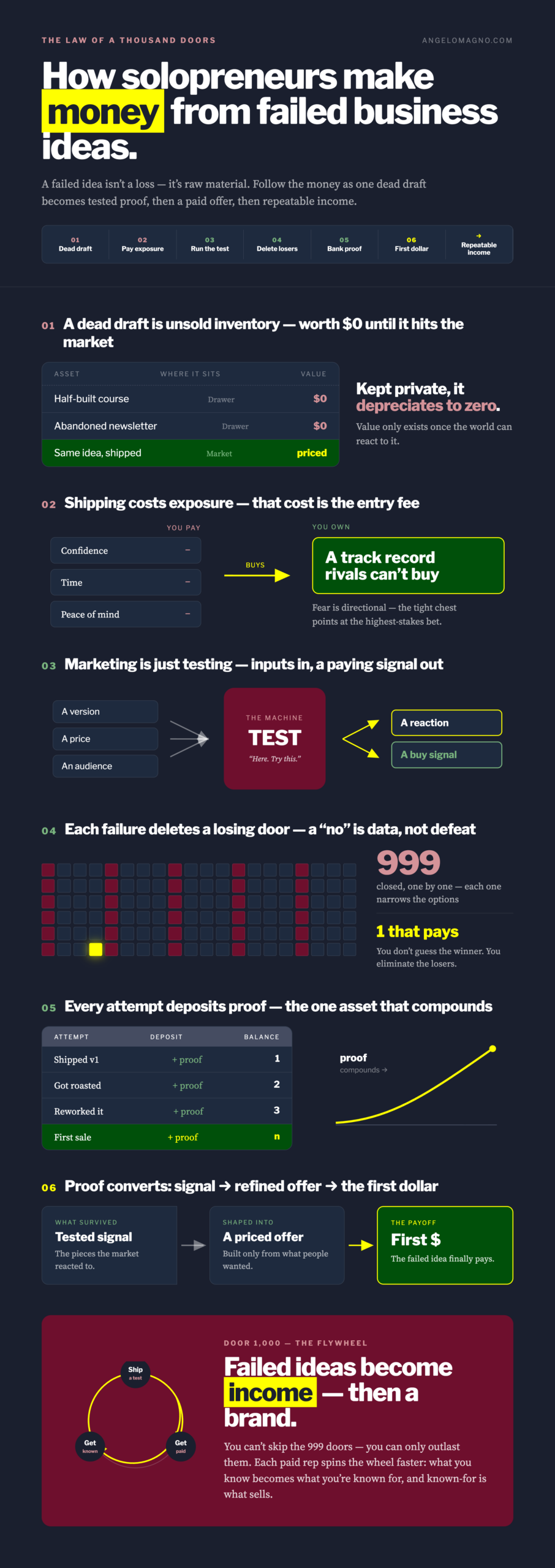
The Law of a Thousand Doors is a mental model that says success comes from exhausting the wrong options, not from finding the right one on the first try.
You don’t win by discovering the single door that leads to your dream.
You win by discovering the 999 doors that don’t, one at a time.
It’s not a roadmap.
It’s a sentence about how the game actually works.
Closed doors don’t block the way. They point the way.
They tell you where to go by telling you where you shouldn’t.
Here’s how it plays out in practice:
- You test an idea in the open and take the result, good or bad.
- You read what comes back as direction, not verdict.
- You adjust the idea and test the next version.
- You repeat until the market shows you the one that sells.
How many doors can you take before you break?
That’s the real question the law asks.
Most people quit around the first few doors, because the first few are the ones that make you question whether to knock at all.
The ones who make money from failed business ideas aren’t luckier.
They’re the ones who kept opening doors long enough for the pattern to show itself, which is also the difference between the businesses that reach year five and the half that don’t.
Why doesn’t volume stop most businesses from failing?
Now, a warning, because there’s a trap that looks like the solution.
The internet made it easy for anyone to start, which means everyone’s louder, and it’s getting louder with AI.
A lot of people are using AI to replace themselves instead of enhancing themselves.
They take unpolished ideas, run them through something with no personality, and share at scale, betting that volume will do the work that iteration is supposed to do.
Think about what that gets you.
If you sound like a template, you become one.
That’s not leverage. It’s denial.
And it doesn’t solve the thing that kills most businesses, because a thousand untested posts still add up to no market need.
That’s the catch.
These are people sprinting to skip the struggle, but the struggle is where the scars come from, and the scars are what make you strong enough to stop struggling later.
Unpolished ideas burn fast, and nothing that burns fast lives long enough to matter.
Volume without iteration is a faster route to the same failure, not an escape from it.
How do failed business ideas turn into proof?
So what do all those doors actually give you?
Proof.
Remember, the world doesn’t care about your ideas. It only reacts to them.
Every time you build, test, and share, you leave a trace the world can react to.
That trace is your proof, and it comes in a few forms:
- Reactions that tell you what landed.
- Questions that tell you what confused people.
- Criticism that tells you what to fix.
- Silence that tells you what to drop.
Those aren’t defeats. They’re coordinates.
Together they form a map of what to build more of and what to abandon, and without that map you’re trapped in theory and headed for the same no-market-need cliff as everyone else.
What if the cost of exposure is the whole point?
Proof demands exposure, and exposure costs you.
It costs confidence, time, and peace of mind, and there’s no version where it doesn’t.
But by the time you’ve worked through enough doors, you’re not the same person who knocked on the first one.
The market reshaped your ideas into something you couldn’t have designed alone, something more polished than the draft you were protecting.
How does a failing idea become a business that pays?
Zoom out and the whole thing gets simple, even if it never gets easy.
The reason most businesses fail and the reason most drawers stay full are the same reason: work that never met the market can’t be corrected by the market.
The Law of a Thousand Doors doesn’t ask for hacks. It asks for stamina.
You can’t skip the 999 wrong doors, and no shortcut deletes them.
You can only outlast them.
That’s how what you know turns into what you’re known for.
The failed business idea in your drawer isn’t waiting to be perfect.
It’s waiting to be tested, rejected, reshaped, and tested again, until one version of it is the thing people pay for.
The money was never in the idea.
It was in the exposure you kept avoiding.
So the real question isn’t whether your ideas are good enough yet.
It’s how many doors you’re willing to open before the right one does.
Infographic
FAQ
Why do most businesses fail in the first place?
Most fail because they build something the market never needed.
According to CB Insights, no market need is the top cause, at 42%, ahead of running out of cash.
The Bureau of Labor Statistics shows about half of new businesses close within five years.
The common thread is work that was never tested against real demand before the money ran out.
How do solopreneurs actually make money from failed business ideas?
They treat each failure as feedback instead of a final answer.
A rejected idea gets exposed to the market, and the reactions show what to change.
The solopreneur adjusts and tests again, and repeats until one version connects with people who pay.
The money comes from the iteration the failure made possible, not from the original idea.
Is the Law of a Thousand Doors just a motivational metaphor?
No, it’s a working model for how testing leads to income.
It says you find what sells by ruling out what doesn’t, one attempt at a time.
Each closed door narrows your options and points you toward the next move.
It lines up with the failure data: the businesses that survive are the ones that validated demand instead of guessing at it.
Why not use AI to publish more ideas faster?
Because volume without iteration produces noise, not proof.
Using AI to replace your judgment turns your work into a template that sounds like everyone else’s.
Used to enhance your thinking, it helps you test and refine faster.
A thousand untested outputs still add up to no market need, which is the reason most businesses fail.
What if I expose an idea and it gets rejected hard?
That rejection is one of the coordinates you needed.
Hard feedback tells you something specific about what isn’t working, which is more useful than silence.
The point isn’t to avoid the blow.
It’s to read it, adjust, and open the next door, because the pattern only shows itself across many attempts.