…
Return on Life is a business-selection criterion that asks what the successful version of a business must make possible in your life before you compare its financial upside. To choose a business idea, define the life and operating conditions you want, eliminate models that violate them, then test the survivors for demand and economics.
What if the business works and you still don’t want the life it creates?
Search YouTube for a business to start and the answers begin to blur together. One model promises $10K a month. Another promises $50K. Another promises six figures with fewer hours, higher margins, more automation, or some combination of all four.
The strange part is that the more plausible those opportunities become, the less useful the money can become as a selection rule. If five business ideas can all make enough money, the income number no longer tells you which one deserves your next few years.
That is where the question changes. Instead of asking which business has the largest upside, we can ask what the successful version of each business would make possible in our life, then bring economics back into the decision after that.
Continue reading to know more about:
- How to choose a business idea when several could make money
- What should a successful business make possible in your life?
- Why does money-first selection make shiny objects harder to ignore?
More ways to learn about this topic:
How to choose a business idea when several could make money
Most business-idea research starts with alternatives. Consulting. Micro-SaaS. Newsletters. Digital products. Communities. We compare margins, scalability, demand, startup cost, revenue potential, and whatever new metric the next video introduces.
There is nothing wrong with comparing alternatives. The problem is starting the decision there, before deciding what the alternatives are supposed to accomplish beyond making enough money.
Decision researcher Ralph Keeney described this pattern as alternative-focused thinking. His work on value-focused thinking argues that decisions often begin with available alternatives and only afterward ask which objectives should be used to judge them. He proposed reversing that order by clarifying objectives first. PubsOnline
That distinction maps almost perfectly onto the business-idea loop. If the first question is “Which business has the best economics?”, every new economically attractive model earns a place in the comparison. Research expands the option set without giving us a stable reason to eliminate anything.
What if the hard part is not finding a good option, but knowing what a good option is for?
A business can be excellent without being relevant to you. That is an important distinction because it lets us reject an opportunity without needing to prove that the opportunity is bad.
A profitable agency can be a great business. So can a paid community, a software product, a consulting practice, or a newsletter. The decision is not whether the model works in general. The decision is whether its successful version satisfies the objectives that matter in your case.
Once those objectives exist, research changes jobs. Instead of endlessly producing candidates, research starts eliminating them.
Why can more business ideas make the decision harder?
There is a tempting explanation here: too much choice causes paralysis. There is some evidence for that, but the story is more complicated than the popular “paradox of choice” version suggests.
In the well-known jam experiment by Sheena Iyengar and Mark Lepper, a display with 24 jams attracted about 60% of passing shoppers, compared with roughly 40% for a display with 6. Yet close to 30% of people exposed to the smaller set bought a jar, compared with about 3% of those exposed to the larger set. Columbia Business School now uses the experiment as an early example of choice overload. Choice Architecture Lab
That sounds like a clean case for fewer options. Then a 2010 meta-analysis by Benjamin Scheibehenne, Rainer Greifeneder, and Peter Todd examined 63 conditions across 50 experiments involving 5,036 participants and found the average choice-overload effect was virtually zero, with substantial variation between studies. DOI
If more options are not always the problem, what makes some decisions collapse under them?
That finding matters because the problem in business selection is not simply “too many choices.” Sometimes more alternatives are useful. If you already know what you are looking for, more options can give you a better chance of finding it.
The more specific problem is an expanding set of alternatives without a stable selection rule. If one video tells you newsletters are attractive because of recurring revenue and another tells you micro-SaaS is attractive because of leverage, both claims can be true. Neither tells you which tradeoff you want.
The research loop stays open because the decision itself is underdefined.
What should a successful business make possible in your life?
Return on Life, or ROL, is a way to define the nonfinancial outcomes that make business success worth pursuing for the person building it. It does not tell you that freedom means fewer meetings, no clients, passive income, or a four-hour workweek.
That would simply replace one generic business prescription with another.
ROL is personal by design. Someone may want a calendar filled with coaching conversations. Someone else may want long blocks of solitary product work. A third person may care most about geographic flexibility, predictable evenings, creative control, or the ability to disappear for two weeks without the business stopping.
The useful criteria tend to fall into a few categories:
- Work: What kind of work fills a normal successful week?
- Time and autonomy: How much control do you want over when and where that work happens?
- Obligations: What customers, systems, maintenance, or responsibilities come with the model?
- Financial requirements: What must the business earn for the rest of the design to be viable?
Those are not universal standards. They are inputs into a decision.
Would you still choose the business if someone showed you the calendar that comes with succeeding at it?
That question changes how we look at a business model. “Fractional consultant” stops being a revenue opportunity and becomes a future filled with a capped client roster, calls, dashboards, advice, and ongoing client responsibility.
Micro-SaaS becomes product maintenance, customer support, bugs, development decisions, and recurring software revenue. A digital asset and content business becomes publishing, audience development, products, memberships, and the obligation to remain useful to that audience.
The descriptions may be imperfect. The point is not prediction accuracy. The point is making the hidden operating life visible enough to react to it before financial upside takes over the decision.
How can AI help test a business idea without choosing for you?
An LLM is useful here because it can generate scenarios fast. That makes it a good assistant for expanding the information around a decision, but a poor substitute for deciding what you value.
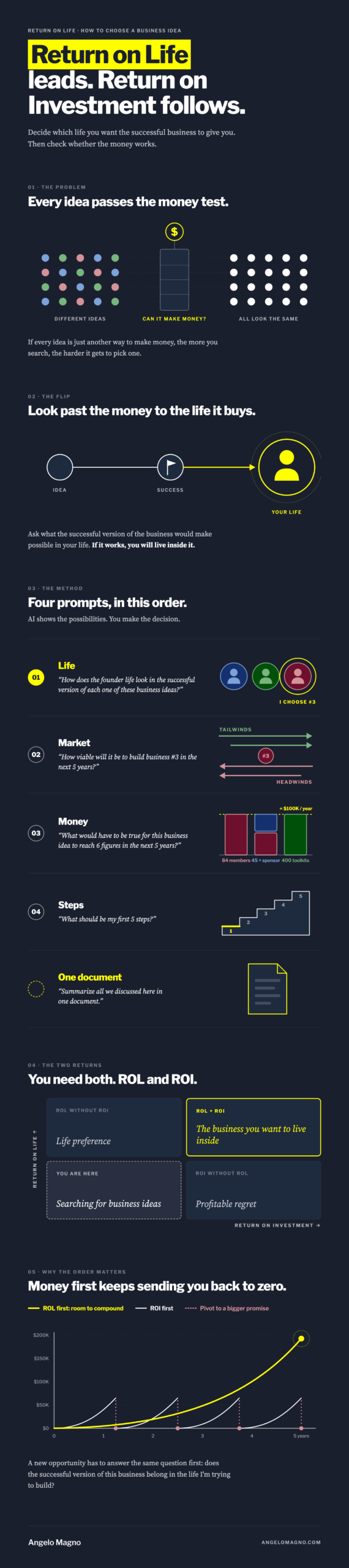
In the video, the process begins with a generic prompt for online business ideas. The result includes fractional consulting, micro-SaaS, and digital assets. Instead of asking the model to rank them, the next prompt asks what founder life looks like in the successful version of each.
That shift is small in wording and large in consequence. We stop asking AI to tell us what to want.
What if AI is more useful as a mirror for a decision than as the decision-maker?
A practical sequence looks like this:
- Generate plausible alternatives. The goal is a workable set of options, not an exhaustive catalog.
- Model the successful operating life. Surface the work, obligations, schedule, maintenance, customers, and tradeoffs behind each model.
- Test the surviving option. Examine market conditions, demand, economics, acquisition, retention, and what would have to be true for the model to produce the required return.
- Convert research into action. Ask for the first steps, document the assumptions, then move into contact with the market.
In the video example, the digital asset and content model survives the personal filter, so the investigation gets harder. What tailwinds and headwinds shape the market? What would need to be true for the business to reach six figures? How many buyers might that require? What kind of problem must it solve? How will people find it and why will they stay?
AI can produce questionable numbers and optimistic forecasts, which is exactly why AI-assisted and AI-led are not the same process. The model can surface assumptions. The founder still has to test them.
This is also where ROI returns to the decision. Once a business is desirable enough to investigate, we can ask whether demand exists, whether the economics can work, and whether the investment of time and money has a plausible return.
That order prevents a useful personal filter from becoming fantasy.
ROL without ROI is a life preference, not necessarily a viable business.
ROI without ROL can be a profitable business you wish you had never built.
Why does money-first selection make shiny objects harder to ignore?
Suppose you choose a business because it appears to offer the strongest financial return. Six months later, another model appears with higher margins, faster growth, better leverage, or a larger income claim.
What reason do you have to stay?
If financial upside was the criterion that made the first opportunity win, a better financial promise has a perfectly logical claim to replace it. The problem is not a lack of discipline. The original selection rule keeps reopening the decision.
What happens when every new opportunity is allowed to compete on the one metric that made the last one win?
Return on Life gives the decision a more stable reference point. A new opportunity does not become relevant because it can make money. It first has to produce a successful operating life that belongs inside the life you are trying to build.
This also corrects an unfair comparison we rarely notice. The business we already have is judged through reality: customer problems, boring tasks, uncertainty, bad weeks, maintenance, and work. A new business is judged through possibility: upside, novelty, clean projections, and someone else’s success story.
That asymmetry makes switching feel rational even when the comparison is not.
ROL does not forbid adaptation. The business model may need to change as customers respond, skills develop, distribution channels shift, or assumptions fail. The stable thing is not the current implementation. The stable thing is what the business is trying to make possible.
That is how a decision begins to compound instead of restarting every time the market produces a more exciting headline.
Where can Return on Life go wrong?
ROL is not a shield against uncertainty. It is not a way to design a perfect business on paper, and it should not become an excuse to reject any path containing discomfort.
Some information only appears after the decision meets reality. You may discover that you enjoy work you expected to dislike, that customers value a different part of your expertise, or that the distribution channel you planned around is unsustainable.
How much of the business can you know before the market has had a chance to answer back?
Four failure modes are worth watching:
- Copied preferences: Choosing someone else’s version of freedom simply recreates the original problem with different criteria.
- Fantasy economics: A desirable founder life cannot compensate for weak demand or economics that never close.
- Confusing destination with transition: The early build phase may require work that the mature business should not require forever.
- Frozen criteria: What you value can change as experience gives you information you did not have when you started.
This is why ROL is better treated as an objective function than a detailed five-year forecast. You are deciding which direction deserves real-world learning, not predicting the exact business you will operate years from now.
The business you eventually build may differ from the one you initially select. That does not make the original decision useless. A good decision can choose the right direction without pretending to know the final destination.
What changes when the decision has a stable rule?
Research needs a stopping condition. Without one, every new piece of information can justify another comparison, another video, another spreadsheet, another business model.
A stable decision rule gives new information somewhere to land. Does this opportunity produce the kind of successful operating life I want? Can it clear the economic constraints I need? If not, it can be interesting without becoming relevant.
What changes when a new opportunity has to qualify before it can reopen the decision?
That is Decision Closure in practice. The decision is not permanently sealed. New evidence can still matter. What changes is that novelty alone no longer earns the right to restart the process.
And that may be the deeper value of putting Return on Life before Return on Investment. It does more than help us choose a business. It gives the business we choose enough time for skills, audience, reputation, systems, and judgment to compound.
The goal is not to research your way to the perfect business before you begin. It is to choose a business whose success you would want, verify that the economics deserve a real test, and then stay with the decision long enough for reality to teach you what it can become.
Listen to the podcast
Infographic
FAQ
Is Return on Life just another name for a lifestyle business?
No.
Return on Life does not prescribe a low-work, low-revenue, asynchronous, or client-free business.
It asks what outcomes make business success worth pursuing for the person making the decision, which means two founders can choose very different operating models and both have high ROL if those businesses fit the lives they want.
Should I ignore income when choosing a business idea?
No.
Financial return remains a real constraint because a business that cannot support itself or meet your income requirements is not rescued by good lifestyle fit.
The difference is sequence: ROL helps decide which successful outcomes are worth wanting, then ROI tests whether the surviving opportunity can justify the investment required to build it.
What if I do not know what kind of life I want yet?
You do not need a complete life plan.
Start with the operating conditions you can already distinguish, such as work you want more or less of, obligations you are willing to carry, schedule constraints, autonomy, and the income floor the business must eventually clear.
Real-world experience can refine those criteria after you begin.
Can AI choose the right business idea for me?
No.
AI can generate alternatives, describe possible founder lives, surface market assumptions, model economics, and help organize the first steps.
Those functions can improve the information around the decision, but the model cannot determine which version of success is worth wanting for you.
That judgment remains the founder’s part of the process.
Blueprint