
…
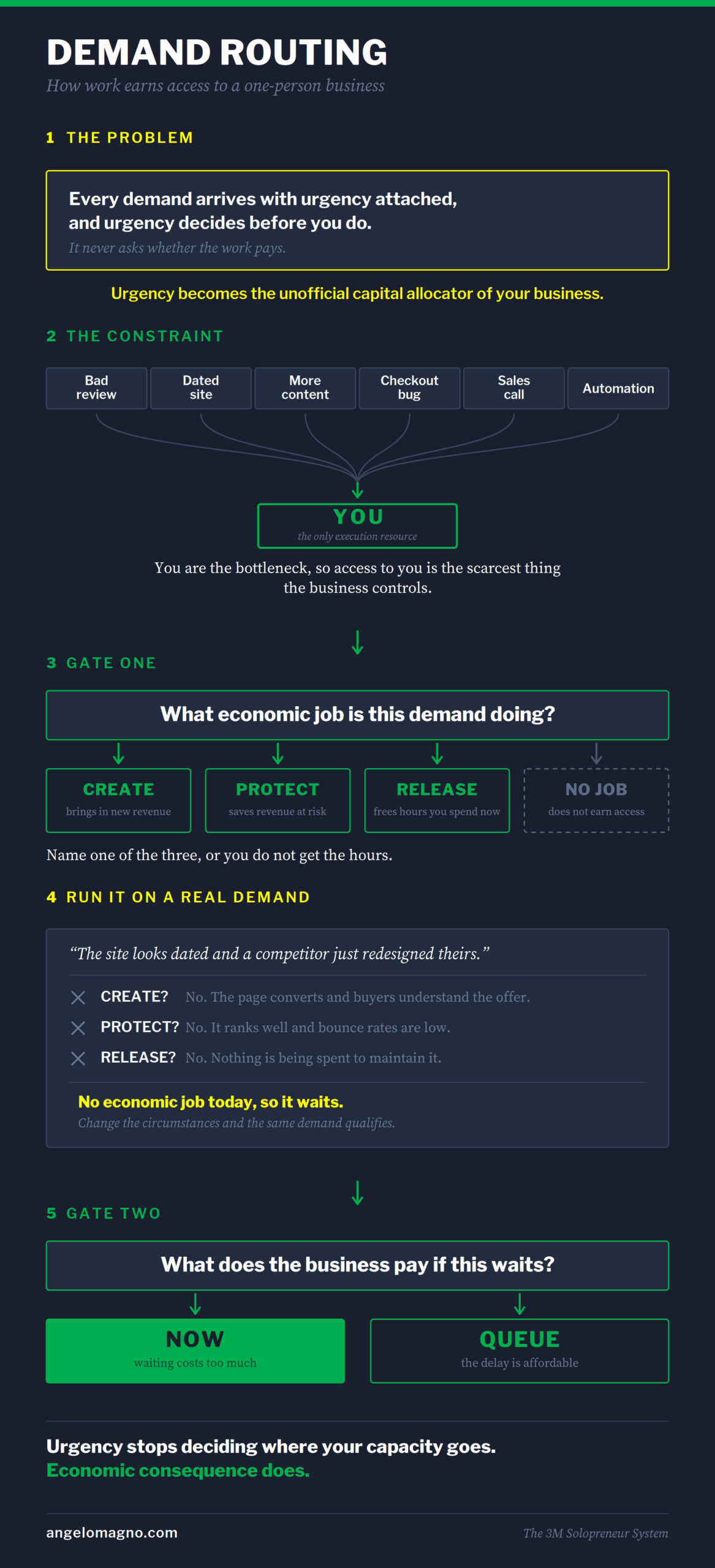
Demand Routing is a decision filter that sends work to a solopreneur based on its economic consequence instead of its urgency.
Before a task gets access to your capacity, it has to name the economic job it performs:
- CREATE revenue
- PROTECT revenue
- RELEASE capacity for revenue

Here is a question worth sitting with before anything else.
How quickly can your business turn a priority into cash?
The gap between the work and the money is where the expense lives, and for a one-person business that gap gets costly faster than most people expect. This is the part solopreneur time management keeps missing.
You can run at full capacity and still starve the business of income.
That sounds like a contradiction until you notice what a one-person business is: unlimited demands competing for one constrained execution resource.
Every new thing that shows up wants a piece of you.
Continue reading to know more about:
- What is the real bottleneck in a one-person business?
- What economic job is this demand doing?
- Where does this break down?
More ways to learn about this topic:
Why doesn’t solopreneur time management fix the revenue problem?
We tend to file this under prioritization. Too many things competing for attention, so we go looking for a better way to sort them. That instinct is where most solopreneur time management advice starts and stops, and it is also where it fails.
Think about the actual sequence for a second. The moment a new demand appears, urgency arrives attached to it.
Before you have a chance to sort anything, the urgency has told you what to handle first. The sorting system never gets consulted, because the decision was made before the system was invoked.
What if the problem shows up before prioritization even begins?
That timing is the whole issue. A matrix, a ticket system, a color-coded list: none of them run early enough to matter.
By the time you are sorting, urgency has acted as the unofficial capital allocator of the business. It decided where your scarcest asset went, and it did so without asking whether the destination pays.
What does the wasted capacity actually cost?
The data suggests this is not a rare failure. A survey of 251 U.S. entrepreneurs reported by Forbes found the average entrepreneur spends 36% of the workweek on small administrative tasks like invoicing and data entry.
Notice that none of those tasks are irrational. They all had a reason for being there, which is the part that makes this hard. More than a third of the constraint’s capacity went somewhere defensible and produced nothing you could point to on an invoice.
There is a second-order problem hiding in that number. Most solopreneur time management advice treats those hours as an efficiency loss, something to compress with better tools or tighter batching.
Compress them and you free hours, which is a real gain. But freed hours flow back into the same allocation process that misdirected them the first time, and urgency is still standing at the front of the queue.
Efficiency without a routing decision hands the reclaimed time straight back to whatever shouts loudest.
What makes urgent work so convincing?
Every urgency shows up with a lawyer. A bad customer review arrives with an argument about trust. The dated website comes with a case about conversion.
Content that is not getting traction brings a story about stalled growth. They can all build a compelling case for why they deserve you, and here is what makes that dangerous: most of those cases are technically true.
The review does affect trust. The website does affect conversion. The argument is sound, and the work can still be the wrong place for your capacity today.
If every demand can justify itself, what is a justification worth?
That is the question I keep landing on. When every request can produce a defensible reason, reasons stop functioning as a filter. A filter that admits everything is not a filter.
And something else rides along with each urgent demand, quieter than the lawyer: part of your business cost belongs to the work you are not doing.
What is the real bottleneck in a one-person business?
In The Goal, the business novel that introduced the Theory of Constraints, Eliyahu Goldratt and Jeff Cox define a bottleneck as “any resource whose capacity is equal to or less than the demand” placed on it.
For a solopreneur, that resource is you. Not your calendar, not your tools, not your systems. You are the constraint the entire operation runs through.
Why does this hit a solo business harder?
In a factory, you can route work around a bottleneck or add capacity beside it. A solopreneur has neither option, which means every hour that passes through you is an allocation decision whether you treat it as one or not.
Solo entrepreneurs spend roughly 68% of their time working in the business rather than on it, according to time-use figures compiled by Venturu. Two thirds of the constraint’s capacity goes to running what exists.
This is also why solopreneur time management breaks down at a level that better habits cannot reach. In a company, a bad allocation decision costs one person’s afternoon and the organization absorbs it.
In a one-person business, that same decision costs the entire productive capacity of the firm for that block of time. There is no redundancy to hide the error, which is why a mistake that reads as minor inside a team reads as expensive when you are running alone.
Does something deserve your capacity because it can make a strong case for your attention?
That question is the hinge. If you are the bottleneck, then access to you is the scarcest thing the business controls. And scarce resources do not get handed out on the strength of an argument.
What economic job is this demand doing?
So the filter has to run earlier than prioritization, at the moment a demand asks for access. Demand Routing is a filter that asks one question before any work reaches you: what economic job is this demand doing? Three answers qualify.
- CREATE is work that brings net new revenue into the business.
- PROTECT is work that keeps revenue that exists but is at risk.
- RELEASE is work that frees capacity currently trapped in recurring tasks.
The value here is translation. Unrelated demands (a sales conversation, a broken checkout, an automation project) become comparable because they are expressed in the same economic language. A demand that cannot name one of the three has not earned access.
What if the question is not which work matters most, but which work is doing an economic job right now?
That distinction carries more weight than it first appears. Mattering is a property of the work. Doing an economic job is a property of the work inside your current circumstances, and circumstances change the answer.
Does this hold up against real decisions?
Plain enough in theory, so let us test it where it should break.
The homepage redesign
The site looks dated and a competitor refreshed theirs, so there is a real case that your brand should keep pace. Now run the filter.
Does it CREATE revenue, if the page converts and buyers understand the offer? No, because the current version meets its conversion goals.
Does it PROTECT revenue, if the page ranks well and bounce rates are low? No, because nothing points to design holding sales back.
Does it RELEASE capacity, if nothing is being spent maintaining it? No. The demand produces no economic job, so it should not get access to you.
More content
Here the pull is stronger, because there is always a case for publishing more. But suppose your content brings in qualified leads beyond what you can handle.
More leads do not CREATE revenue when the constraint sits downstream of lead generation. Nothing is at risk, so there is nothing to PROTECT. And producing more requires more of your hours, so it cannot RELEASE capacity.
Notice what the filter removed: not nonsense, but work that sounded strategic.
That is the part worth slowing down on. Both examples were legitimate, and both would pass any reasonable smell test.
The same two demands would qualify immediately under different circumstances, and that is not a weakness in the filter, it is the filter working. A redesign on a page that is bleeding conversions does a PROTECT job. More content, when your pipeline is thin, does a CREATE job.
What happens when several demands all qualify?
Here is the harder case, and it is the one that shows up most. You have a sales opportunity that CREATES, a checkout problem that PROTECTS, and a fulfillment process that could RELEASE ten hours a month once automated.
All three earned access, and all three are competing for the same constrained resource. The second question sorts them: what does the business pay if this waits?
Some go Now, because waiting costs too much. Some go to the Queue, because the delay is affordable relative to what is ahead of them. The routing runs in sequence:
- First, does this demand do an economic job?
- Then, what does the business pay if it waits?
Instead of urgency deciding where capacity goes, demands get routed by economic consequence. That sequence is what separates this from most solopreneur time management systems, which sort a list without asking whether the items belonged on it.
Where does this break down?
I want to be honest about the limits, because a filter this clean invites misapplication. Some work has a real economic job on a horizon longer than a quarter, and reading it against this month’s revenue will kill things worth keeping.
Brand building and skill development both fail a short-horizon test while paying for years, so the timeframe you apply is doing as much work as the filter itself. Some work has no economic job and belongs in your life anyway, for reasons that have nothing to do with money.
And the filter depends on knowing your own numbers well enough to give a true answer, which is a prerequisite rather than a footnote. Run it on guesses and you get confident, well-structured, wrong answers.
The three jobs are easy to reverse-engineer, which is the failure I would expect first.
Any demand you want to do can be dressed as a CREATE with enough imagination. At that point solopreneur time management has gained a vocabulary without gaining a filter.
The question only works if you are willing to hear no from it, which makes this less a system than a habit of honesty applied at the moment of access.
What does this change about how you see the business?
Zoom out and something larger comes into view. We opened by asking how quickly your business turns a priority into cash. There is a harder question underneath it: how quickly does that cash turn into the life you wanted?
Every time you decide what deserves your capacity, you are deciding what kind of work gets built into the business. The work you keep accepting becomes part of the business model. Accept enough urgent maintenance and you have built a maintenance business, whatever you meant to build.
Which means you can follow the money, make defensible calls, grow the numbers, and wake up inside a business you do not want to run. That is where return on investment stops being a sufficient measure.
A business can produce a strong return on investment and a poor return on life.
Demand Routing starts as a way to protect your capacity from urgency. Sitting with it longer, I think it does something else.
It makes visible the fact that you have been designing the business all along through what you agreed to do, and most of those agreements were made by urgency rather than by you.
Podcast
Infographic
FAQ
Isn’t this prioritization with different labels?
No, and the difference is timing. Prioritization sorts work that has reached you. Demand Routing decides whether work reaches you at all, by requiring each demand to name an economic job first.
By the time a prioritization system runs, urgency has usually made the call. The filter has to sit earlier in the sequence to change anything.
What about work that matters but has no economic job?
Some of it belongs in your business anyway, and the filter does not pretend otherwise. Brand work, relationships, and learning often pay on horizons this month’s numbers cannot see.
The point is not to strip everything that fails the test. It is to know when you are spending scarce capacity on something that is not doing an economic job, so the choice is deliberate rather than automatic.
Doesn’t this make a solopreneur too focused on money?
It can, if the two questions are used alone. Demand Routing tells you what work the business can afford, not what work is worth doing with your life.
That is why the second measure matters. A business can post a strong return on investment while returning little to the person running it, and no filter built on economic consequence will catch that on its own.
How do I answer these questions without good data?
Carefully, and with the awareness that the filter inherits the quality of your inputs. If you do not know your conversion rate, your lead volume, or where revenue is at risk, the three jobs turn into guesses wearing a framework.
Start with the numbers you can verify. An honest answer on one demand is worth more than a confident routing decision applied across all of them.
Blueprint