…
AI productivity is an increase in business speed or output created by AI tools, but it produces business value when that output reflects what customers want.
For solopreneurs, the risk begins when automation removes them from the customer evidence and founder learning needed to guide revenue-producing work.
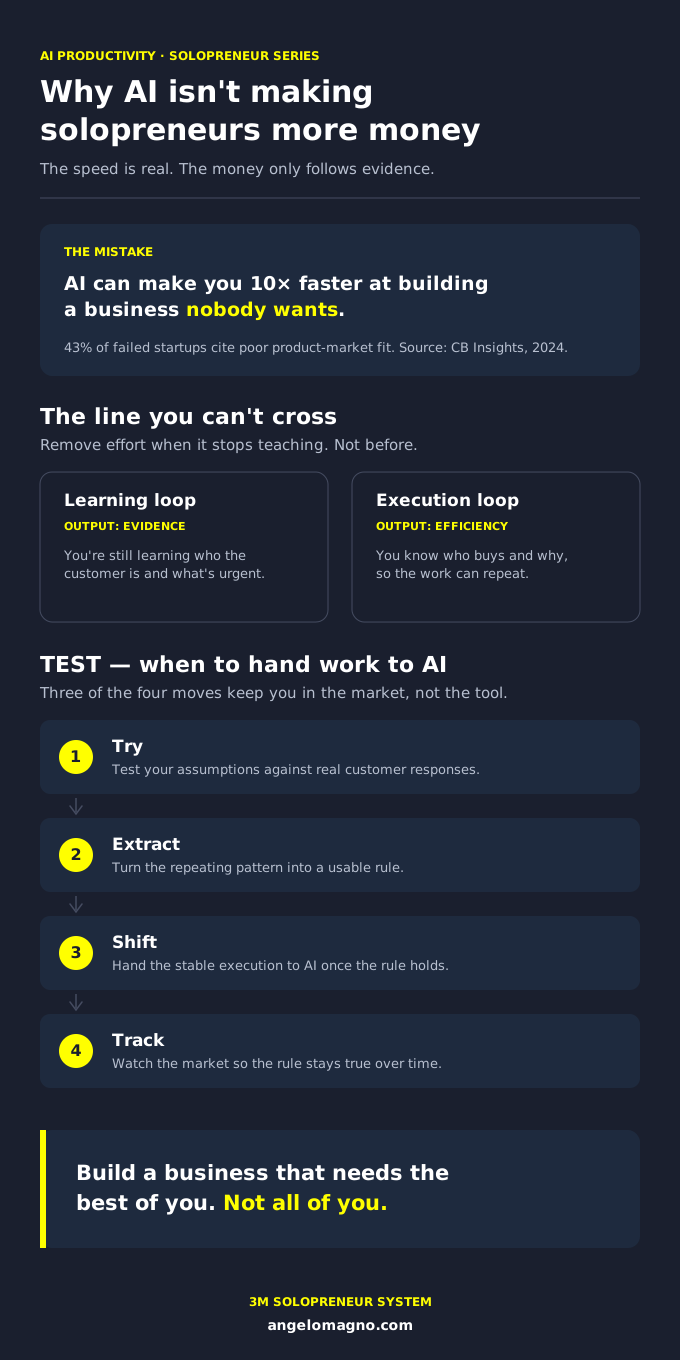
As a solopreneur, AI can make you ten times faster at building a business nobody wants.

Give it false assumptions about why customers buy, and it can turn those assumptions into outreach, proposals, follow-ups, and an entire sales funnel leading nowhere.
- The system can run.
- The content can ship.
- The activity can fill a dashboard.
And revenue can sit there looking unimpressed.
That raises a question we keep missing.
When we delegate work to AI, are we removing a task, or are we removing the experiences teaching us why customers buy?
Why can AI productivity rise without increasing revenue?
AI productivity measures how much output a business creates with a given amount of time, effort, or money.
Revenue measures whether the market values that output enough to pay for it.
Those are connected, but they are not interchangeable.
AI can help us create ten proposals in the time it once took to create one.
But if the offer solves a problem customers do not consider urgent, those proposals multiply activity rather than demand.
What if AI productivity is increasing the amount of work without improving the reason anyone would buy it?
This gap is showing up beyond one-person businesses.
A 2026 PwC study of 1,217 executives found that 20% of companies captured 74% of the economic value attributed to AI.
The strongest group was twice as likely to redesign workflows instead of placing AI tools on top of existing work.
Their AI-driven revenue and efficiency gains were 7.2 times those of the other companies.
Large companies are not solopreneurs, so we should not pretend those figures transfer without friction.
But the pattern raises the same uncomfortable possibility.
Using more AI and creating more value may be two different projects.
How can AI automation scale the wrong business assumption?
An AI business assumption is a belief about the market that guides what an automated system produces.
It might concern the customer, the problem, the message, the offer, or the reason someone will buy.
A new business contains a stack of these beliefs.
- We think this customer has this problem.
- We think the problem matters now.
- We think this promise will earn attention.
- We think the offer will feel worth the price.
AI does not pause at the edge of that theory and ask whether the market agrees.
It uses the information we provide.
Could a system work as designed while the business inside it remains wrong?
Give AI a false belief about customer urgency and it can spread that belief through:
- Prospect targeting
- Outreach messages
- Qualification rules
- Proposals and follow-ups
The automation may perform each task without error.
That makes the failure harder to notice because nothing appears broken.
We may rewrite prompts, switch tools, or add another AI agent when the real problem sits beneath the workflow.
The system is executing a business theory that reality has not validated.
What should solopreneurs automate with AI?
The easy answer would be to keep AI away from important work.
That creates a different problem.
We do not want to spend our lives repeating clerical tasks while a business waits for our attention.
Refusing automation can waste the same time premature automation claims to save.
So the useful boundary may not sit between human work and AI work.
It may sit between a learning loop and an execution loop.
What changes when we judge work by what it produces besides the task itself?
In The Lean Startup, entrepreneur Eric Ries writes, “I’ve come to believe that learning is the essential unit of progress for startups.”
Ries uses validated learning to separate market evidence from comforting stories about progress.
His argument gives us a sharper way to consider AI productivity.
Effort that contributes nothing to learning can leave our hands.
The harder question is whether the work has stopped producing knowledge the business needs.
That is where learning loops and execution loops begin to separate.
What is a learning loop in AI automation?
A learning loop is a business process that reduces uncertainty through action, customer response, and interpretation.
We are not repeating known work inside this loop.
We are discovering who the customer is, which problem creates urgency, what earns trust, and why someone hesitates.
The visible output might be a sales call, a piece of content, a proposal, or an onboarding session.
But the process produces a second output.
It improves the founder’s understanding of the business.
What if the work we want to eliminate is still correcting what we believe?
A sales conversation can reveal the words customers use when the problem hurts.
A rejected proposal can expose a promise that felt important to us but weak to the buyer.
An onboarding call can uncover a gap between what the marketing implied and what delivery requires.
In a learning loop, unusual reactions are not interruptions.
They are evidence.
AI can transcribe conversations, group objections, compare patterns, and prepare follow-up questions.
But if it shields us from the reactions that could change our judgment, the time savings may keep the business wrong.
What is an execution loop in business automation?
An execution loop is a repeatable business process whose outcome, quality standard, common variations, and important exceptions are understood.
The process may still require monitoring.
It may still encounter errors.
But repeating it no longer changes a core assumption about how the business works.
That makes it a stronger candidate for AI automation.
Research can follow known criteria.
Qualification can use evidence-backed conditions.
Follow-ups can reflect language customers have shown they recognize.
Proposals can draw from an offer that has produced consistent buying behavior.
When does founder involvement stop producing insight and start producing repetition?
This is where AI productivity can become leverage.
The solopreneur does not disappear from the business.
Their attention moves toward uncertainty while AI carries stable execution.
The distinction also prevents a common overcorrection.
Human judgment does not need to remain inside every step because one exception might appear one day.
The process needs a clear route for judgment to return when the exception matters.
Automation readiness is not perfection.
It is enough operational knowledge to define success, detect failure, and recognize when the business needs to learn again.
How does the TEST framework measure AI automation readiness?
The TEST framework is an AI automation readiness process that moves work from uncertainty to stable execution while preserving contact with market feedback.
It stands for Try, Extract, Shift, and Track.
The sequence matters because AI can execute a process before the business understands what should guide that execution.
TEST asks the process to earn automation through evidence.
What would change if automation began with a market test instead of a software capability?
The framework follows four movements:
- Try the business assumption against reality.
- Extract a usable rule from the response.
- Shift stable execution to AI.
- Track whether the market continues to support the rule.
AI does not wait outside the framework.
Its role changes across it.
During uncertainty, AI can help collect and compare evidence.
After the business learns enough, AI can carry more execution.
When customer behavior changes, the process returns to learning.
That makes TEST a reusable way to ask what AI is ready to take over and whether that decision still holds.
How does Try test customer assumptions?
Try is the TEST stage that exposes a business assumption to customer behavior before automation scales it.
Imagine that you want AI to automate how you acquire clients.
The steps repeat each week.
You find prospects, research them, send messages, answer replies, prepare proposals, and follow up.
The process appears ready because each step can become a prompt or workflow.
But the visible steps are not the whole process.
A belief sits underneath them.
You believe you know why clients buy.
Do you know that, though?
Or do you know why you think they should buy?
How much automation can a business theory support before customers have tested it?
Staying inside a few attempts can produce different responses.
One prospect says the offer sounds useful.
Another says the problem is not a priority.
A third asks how soon you can begin.
Those reactions are not equal evidence.
Interest, urgency, and purchase behavior point to different levels of demand.
Try does not ask AI whether it can perform the funnel.
It asks the market whether the theory inside the funnel deserves more execution.
How does Extract turn customer feedback into business knowledge?
Extract is the TEST stage that converts repeated customer evidence into a usable business rule.
Suppose the third response becomes a pattern.
The people who act are not those who see some value in the offer.
They are the people experiencing a condition that makes the problem expensive, urgent, or hard to ignore.
That difference can reshape the customer profile, positioning, qualification criteria, sales language, and offer.
The assumption has not become truth for all time.
But the business can make a stronger decision than it could before the test.
When does a customer reaction become a pattern the business can use?
One enthusiastic reply is not enough.
A collection of polite responses may not be enough either.
Extraction requires us to compare what people say with what they do.
Do they schedule the call?
Do they accept the proposal?
Do they pay?
Do the same conditions appear across the customers who act?
Experience becomes business knowledge when we can state a rule that improves the next decision.
AI can organize the evidence and surface repetition.
The founder still has to decide which pattern carries weight.
When should solopreneurs Shift execution to AI?
Shift is the TEST stage that transfers stable parts of a process to AI after evidence has reduced the important uncertainty.
Once we understand which customer conditions create urgency, we may not need to remain inside every part of client acquisition.
AI can support research, qualification, routine follow-up, call summaries, and proposal preparation.
The founder can stay close to objections, unusual responses, lost deals, and decisions that could change the rule.
We are not automating sales as one indivisible system.
We are transferring the parts that market evidence has made repeatable.
Could AI take more of the work without taking us away from what still matters?
That question keeps Shift from becoming another automation checklist.
A task may contain stable execution and unresolved learning at the same time.
Research might follow a known profile while the offer remains under test.
Follow-up timing might be stable while objection handling still needs founder judgment.
Shift can happen at the level of a step rather than an entire department.
The goal is not maximum automation.
It is enough automation to free attention without breaking the feedback loop.
How does Track keep AI automation connected to the market?
Track is the TEST stage that checks whether the market conditions supporting an automated rule remain valid.
A workflow can perform as designed while its business knowledge expires.
Six months after the shift, conversion may fall and new objections may appear.
The first reaction might be technical.
We inspect the prompt, blame the model, add personalization, or replace the AI tool.
But what if the automation is not broken?
What if the market it was built for has changed?
Could yesterday’s evidence become today’s automated mistake?
Track compares performance with the assumptions underneath the workflow.
- Are the same customers responding?
- Are the same conditions creating urgency?
- Are prospects hesitating for a new reason?
Has the problem moved somewhere else?
A Federal Reserve research paper based on a survey of close to 750 executives found a gap between perceived and measured AI productivity gains, with delayed revenue among the possible explanations.
That does not prove the same mechanism in every solopreneur business.
It does remind us that felt speed and measured outcomes can separate.
Track gives the learning loop a way back into execution when reality changes.
How should AI productivity serve a one-person business?
AI productivity can give one person access to output that once required a team.
That changes what a solopreneur can build, test, and operate.
But the market keeps offering a tempting shortcut.
First came formulas.
Then playbooks.
Now AI agents promise to run the whole business.
What if the part we are encouraged to skip is the part that develops the founder capable of making the business work?
That seems less like freedom and more like a new form of dependence.
What kind of one-person business are we building if the founder never learns how it works?
Serious solopreneurship may require a harder balance.
We stay close enough to customers for reality to correct the business in our heads.
We extract rules from those corrections.
We build systems around what survives.
Then AI carries the work that no longer needs our attention.
That is not a rejection of AI automation.
It is a demand that automation serve the business we are trying to understand.
AI should help us become better founders instead of removing us from the experiences that make that growth possible.
Don’t build a business you have to escape from.
Build one that needs the best of you, not all of you.
Infographic
FAQ
Can AI automate client acquisition for a solopreneur?
Yes, AI can support prospect research, qualification, outreach, follow-up, call summaries, and proposal preparation.
The question is whether the targeting, offer, and buying conditions have enough market evidence behind them.
If those elements remain uncertain, automation should increase exposure to customer feedback rather than remove the founder from it.
How do I know when a business process is ready for AI automation?
A process may be ready when the outcome is understood, quality can be recognized, common variations are mapped, and repetition no longer changes a core business assumption.
TEST provides a practical check through Try, Extract, Shift, and Track.
Readiness does not mean the process will never change.
It means the stable execution can be transferred while feedback remains visible.
Does protecting learning loops mean using less AI?
No.
It means giving AI a different role while the business remains uncertain.
AI can capture conversations, compare objections, organize evidence, prepare experiments, and reduce clerical work.
Once the business extracts a stable rule, AI can take over more execution.
The amount of AI may increase while founder contact with the lesson remains intact.
What if an AI automation works but conversions begin to fall?
The process may still be executing its instructions while the market rule underneath it has changed.
Check whether the same customers are responding, whether the same problem creates urgency, and whether new objections repeat.
A prompt update may help when execution is broken.
A return to the learning loop may be needed when customer behavior has changed.