…
A business AI can’t replace is one built around the assets that grow scarce as AI makes production cheap:
- Recognition
- Trust
- Reputation
Because that is the one thing AI cannot manufacture overnight.

What if the thing everyone is racing to build is the thing about to lose its value?
Open your feed and you can watch a business model getting sold in real time.
- AI agencies
- Faceless YouTube channels
- AI apps shipped overnight.
If you are building a one-person business while AI reshapes how the work gets done, ignoring all of that feels like denial.
Nobody wants to reach 2030 and realize everyone saw the opening except them.
That sounds reasonable.
The trouble is that reasonable and valuable are not the same thing, and the space between them is where this whole question lives.
Continue reading to know more about:
- Why everyone building with AI looks the same right now
- What everyone’s abundance turns scarce
- How to run The Countertrend Test
More ways to learn about this topic:
Why does everyone building with AI look the same right now?
There is a strange sameness flooding the internet these days. The same:
- Offer structure
- Landing pages
- Apps portfolio
The same AI voice flooding our feed.
This is what happens when the cost of producing something falls toward zero and everyone reaches for the same tool at the same moment.
The numbers make the scale hard to ignore.
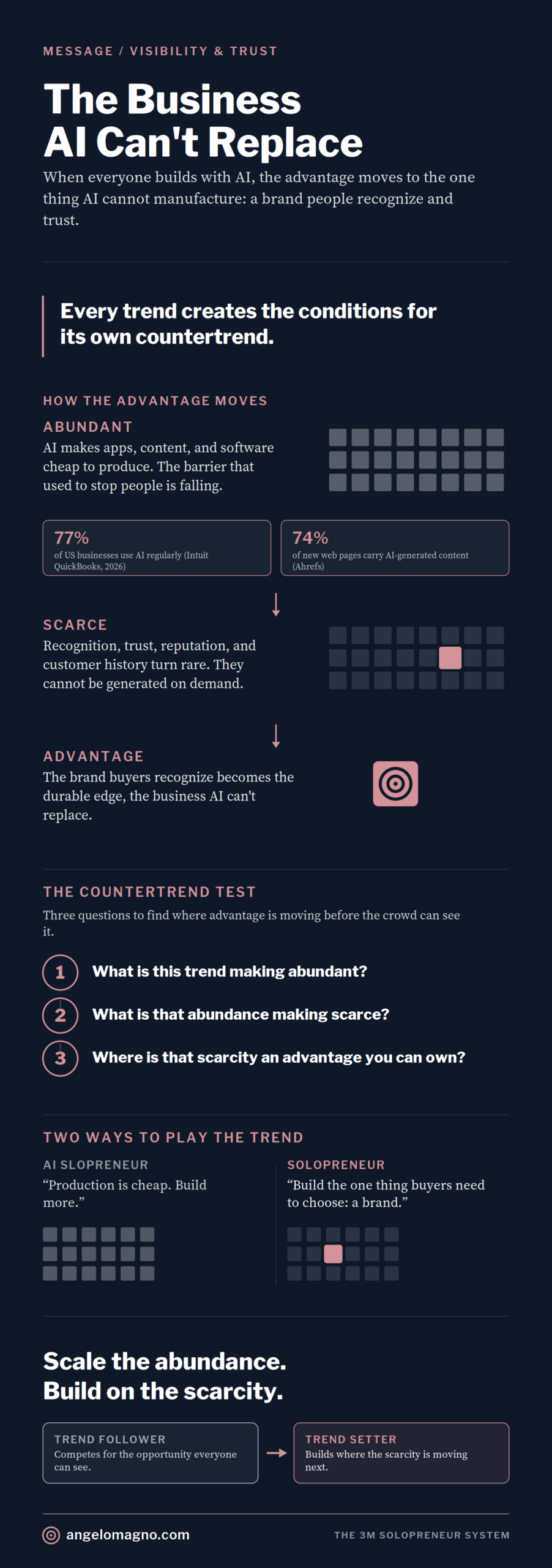
An Ahrefs analysis of roughly 900,000 web pages published in April 2025 found that 74.2% contained AI-generated content, with only a sliver produced by AI alone.
The web is not turning fake. It is turning interchangeable.
What happens to your advantage when the tool that makes your work possible is the same tool everyone else is using?
We tend to assume that whatever a new trend makes possible, it also makes valuable.
When the barrier to producing something drops for you, it drops for everyone, and a capability shared by all is a capability that distinguishes none.
So the interesting question is where the advantage goes once the wave arrives for everybody.
That question, more than any tool you pick, is how you end up with a one-person business AI can’t replace.
What is the AI business boom making abundant?
Every trend changes the supply of something.
In this case, AI is making software, apps, features, MVPs, and content abundant.
The ability to take an idea and turn it into a functioning product, which used to require a team or a technical co-founder, now sits inside a chat window.
Adoption confirms it is a general shift rather than an edge.
The Intuit QuickBooks 2026 AI Impact Report found that 77% of US businesses now use AI regularly, up from 48% in mid-2024.
When three quarters of the market holds the same lever, pulling it is table stakes, not an edge.
If producing the thing is what got cheap, why would producing more of it create an advantage?
This is the assumption worth confronting.
Having something to sell has never meant someone wants to buy it. People do not pour money into a thing because it exists, and a flood of supply does not create the demand to absorb it.
When a market gets saturated with one thing, buyers start hunting for whatever that flood made rare.
Which sets up the real move: instead of chasing the abundance, we look at what the abundance is pushing into short supply.
If everyone can produce, what turns scarce?
Follow the mechanism one level down and it becomes clear. When the supply of something collapses in price, the bottleneck does not disappear.
It relocates to whatever the cheap thing depends on and cannot be mass-produced.
People can spin up an app in a weekend now.
What they cannot spin up in a weekend is a track record, a base of customers who have been served well over years, a reputation that survives contact with skeptics.
As production becomes abundant, recognition, trust, and customer history become the scarce inputs.
If anyone can make the thing, the question buyers face is no longer what to buy but who to trust to make it.
That shift is the whole countertrend.
The advantage moves from the output, which anyone can now generate, to the source, which takes time to build and cannot be faked at scale.
This is what “businesses AI can’t replace” means.
It is not a business that avoids AI. It is a business anchored to the asset AI made valuable by making everything around it cheap: a brand people recognize, support, and pay for.
The advantage lives in the scarcity, and the scarcity is trust.
What is The Countertrend Test?
The Countertrend Test is a three-question lens for finding where a trend is moving the advantage before the crowd can see it. Rather than asking how to join a trend, it asks what the trend is making abundant and what that abundance leaves scarce.
Run it in order:
- What is this trend making abundant, cheaper, or easier to access?
- What is that abundance making scarce?
- Where is that new scarcity creating an advantage my business can own?
The first question names what everyone is rushing toward.
The second points to where the value is draining out of that rush.
The third is where you go to work, because an advantage you can own is one built on the scarce side, not the flooded one.
The test does not hand you certainty.
It gives you a better way to look at change, one that keeps you from mistaking the visible opportunity for the durable one. The visible opportunity is the trend.
The durable one is forming in its shadow.
The SaaS founder who almost threw away the scarce asset
Picture a SaaS founder who has spent years building around one product.
Real customers, a clear position, testimonials, a reputation in a specific market. Good, patient work.
Then AI changes software production, and the feed fills with people launching three micro products a month, someone else claiming a portfolio of ten.
The founder starts to think: why pour everything into one product when I could ship a dozen small ones, price them low, and see what sticks?
Put that instinct through the test.
AI is making apps abundant, so shipping ten is no longer impressive.
What turns scarce is the recognition and customer history the founder has been building for years.
The advantage they can own is sitting inside the thing they were about to abandon.
What if the frustration you feel with your slow single product is pointing at the exact asset the market is about to need more of?
Walking away to compete on volume would mean discarding the scarce asset at the moment the market starts needing more of it.
That does not mean ignoring AI.
It means using AI to ship features faster, improve support, test ideas, and personalize, while compounding the one thing the software explosion cannot manufacture overnight.
The AI slopreneur position shouts that production is cheap, so build more.
The countertrend whispers something quieter:
If production is becoming abundant, build the thing buyers will need in order to choose between all that supply, which is a brand they trust.
Where does the countertrend logic break?
A lens is only useful if you know where it fails, so it is worth pressure-testing this one honestly.
The clearest limit is the founder with no scarce asset yet.
If you are starting out, you have no reputation to defend, and volume is how you find the signal worth compounding. Experimentation comes first, because you cannot protect an asset you have not built.
A one-person business AI can’t replace is something you grow into, not something you launch with.
The countertrend rewards the operator who has something to protect, not the one still searching for it.
A sharper objection:
Is trust not also being faked now, with AI personas and synthetic reviews everywhere?
It is, and that cuts the other way.
The counterfeit market for trust grows because the real thing is valuable, and easy fakery raises the premium on trust that is verifiable and accumulated over time.
When signals get cheap to forge, the hard-to-forge ones are worth more.
There is also the worry that larger players will win the brand game with money and reach.
At scale, sometimes. The one-person operator does not compete on reach, though.
The edge is specificity and relationship, the kind of recognition that comes from one person consistently serving a defined market, which a large brand tends to dilute rather than deepen.
What “businesses AI can’t replace” points to
Step back and the useful part is not the answer but the lens.
When a trend changes the cost, access, or scale of something your market depends on, the move is not to freak out or to pile in.
It is to ask what is becoming abundant, what that leaves scarce, and where the new scarcity hands your business an advantage.
Use the trend to scale the abundance. Take the leverage, let AI strip out cost and friction and time.
Build the advantage around the scarcity forming underneath it, because those two things are moving in opposite directions.
The businesses AI can’t replace are rarely the ones with the best tools.
They are the ones whose owners read the shift early and put their years into the asset that would stay rare.
Competing for the opportunity everyone can see makes you a trend follower.
Learning to see where scarcity is moving before it becomes obvious makes you a trend setter.
Where AI slopreneurs and solopreneurs land in five years is an open question.
The part worth acting on now is smaller and steadier: the crowd is looking at what AI makes cheap, and the advantage is gathering around what it makes rare.
Prefer to listen? Here’s the podcast version
Infographic
FAQ
Isn’t “build a brand” advice that predates AI?
The advice is old.
The reason it matters now is new.
For years a brand was one advantage among many, competing with speed, price, and features.
As AI drives the cost of production toward zero, those other advantages compress, and recognition becomes one of the few that does not.
The Countertrend Test explains why brand moved from useful to load-bearing, rather than treating it as a timeless slogan.
What if I have no audience or reputation yet?
Then the countertrend is not your first move.
With no scarce asset to defend, your job is to experiment and find the signal worth compounding, and volume can help you get there.
Use AI to test faster and learn faster.
The distinction that matters is direction: early on you are building the asset, and later you are protecting it, and the test applies most once you have something to protect.
If AI can fake trust and reviews, isn’t trust cheap now too?
Fakery is real, and it pushes the value the other way.
Counterfeit trust floods a market precisely because genuine trust is worth stealing.
When signals are easy to forge, the ones that are hard to forge (a public track record, a history buyers can verify, years of consistent behavior) command a higher premium.
That is the scarce asset the countertrend points at.
Does this mean I should avoid AI in my business?
No, and treating it that way misreads the argument.
The point is to use AI for the abundant side, shipping, support, research, personalization, while compounding the scarce side it cannot manufacture.
Refusing the leverage would leave real efficiency on the table.
Competing on the abundance is the trap, not using the tool.
How is The Countertrend Test different from picking a niche?
A niche narrows who you serve.
The test locates where advantage is moving as a trend reshapes a market.
You can hold a clear niche and still chase the abundant side of a trend inside it, which is the mistake the test is built to catch.
It works one layer up from positioning, on where durable advantage is forming before it becomes obvious.
Get the blueprint