…
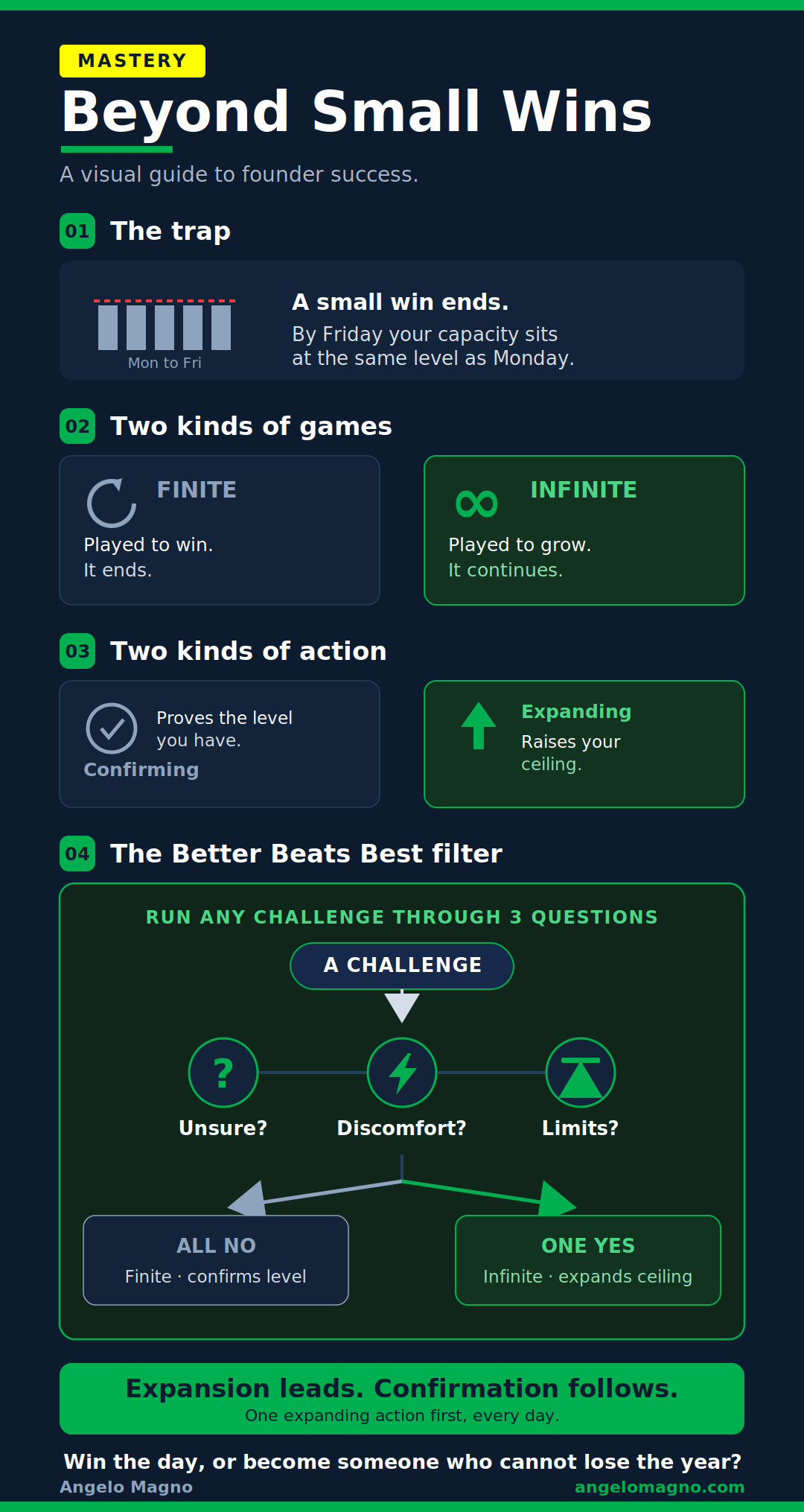
Founder success is a form of long-term growth that expands what a solopreneur can do, rather than a streak of completed tasks. Small wins close finite games and confirm your current level. The deeper version comes from infinite games, the open challenges that raise your ceiling and stretch who you have to become.
Small wins feel useful because they give you proof of motion.
You finish something and get a quick signal that your effort counted.
For solopreneurs, that signal can become addictive.
When no one is grading your work or telling you the strategy is working, small wins can start to feel like founder success.
A small win can prove you are moving without proving you are growing.
That is the tension. The work may be getting done. The founder may still be operating at the same level.
The Problem With Winning the Day
James Carse gives this tension a useful shape in the book Finite and Infinite Games.
- A finite game is played to win.
- An infinite game is played to continue the play.
That difference becomes very real inside a solopreneur’s day.
A lot of work is built around finite games:
- Clearing the inbox
- Publishing content
- Checking metrics
Each task has an ending that gives you a reward, and that reward can start becoming the point.
Winning the day can become a substitute for raising your capacity.
This is where founder success gets blurry.
You can complete a lot of work while avoiding the work that would actually stretch you.
The business looks active, but the person behind it may be staying inside the same level of thinking, skill, and courage.
When Completion Starts Pretending To Be Growth
Completion feels good because it creates closure, and that matters when you are building a business, especially as a solopreneur.
It gives you evidence that the day was used, but completion and growth are different outcomes.
- Completion proves you are capale.
- Growth proves you need to become more.
That difference is easy to miss because both can feel productive in the moment.
Small wins become convincing because you can use them to reassure yourself that the business is moving.
Is your priorities making you feel good, or is it making you better?
Founder success needs both.
But when small wins lead the entire day, capability often gets pushed behind comfort.
Finite vs Infinite Game for Founders Success
Some of your business priorities confirms who you already are. Others stretch who you have to become.
In the first case, you know what to do and what to expect. You can foresee the outcome, even before start.
This kind of work is useful because a business needs execution.
But that’s a finite game. By definition, it has a ceiling. It confirms and rewards the version of you that already exists.
A Finite Game is an identity-confirming action.
In the second case, you DON’T know what to do or what to expect. You CANNOT foresee the outcome, even after you start.
This kind of work is useful because a business needs to evolve.
That’s an infinite game. By definition, it has no ceiling. It requires a version of you that doesn’t fully exist yet.
An infinite Game is an identity-expanding action.
The breakthrough you’re looking for is usually in the work you’re avoiding the most.
This type of work creates a different question.
Can I finish this? becomes less important than who do I have to become to keep playing at this level?
The Better Beats Best Principle
Being better is always better than being the best.
If you’re the best, you won (past tense). You found your ceiling. There’s nothing more that’s required from you to win the game.
If you’re better, you’re winning (present tense). Your ceiling must be pushed higher to keep the winning going.
- The best is a finite game.
- Better is an infinite game.
To identify finite and infinite games inside your daily business routine, you can use the Better Beats Best Principle.
Before you engage in any activity, ask yourself these 3 questions about that activity:
- Will this require me to do something I do not feel confident doing?
- Will this reveal something about my current limits?
- Will this demand real discomfort?
A “yes” to at least one of these questions means that what you’re about to face is an identity-expanding work. An infinite game.
A “no” across all three means that what you’re about to face is an identity-confirming work. A finite game
REMEMBER: Both types of work can are necessary in your business and personal growth and founder success.
They simply build different things.
So what’s the Better Beats Best Principle?
If identity-expanding work makes you better and expands what you’re capable of, it must lead.
Expansion leads. Confirmation follows.
This does not remove small wins, it just changes their role. They stop leading the day and start supporting the day.
For founder success, that shift matters because a solopreneur’s business usually grows only as far as the founder’s capacity allows.
So today, when you sit down to work, are you trying to win the day, or become someone who can’t lose the year?
FAQ
Is the One-Decision RULE too simple for a major life decision?
Yes, it is simple by design. The rule takes a complex decision and forces it to produce one deciding condition. For an employee to solopreneur move, that condition might be runway, client revenue, or a specific date. The simplicity gives the decision a place to land.
What if new information appears after I make the rule?
New information matters when it changes the observable state tied to the rule. If your expenses change, your runway number may need to change. If the information only creates a fresh wave of anxiety while the condition stays the same, it is probably reopening the loop.
What if I choose the wrong criterion?
A wrong criterion creates a visible mistake you can adjust. An open decision creates an invisible drain that can last for years. The useful part is specificity: you can change a number, threshold, or timeline once you see what the first version missed.
Does a decision-making rule reduce freedom?
A decision-making rule trades the freedom to reconsider for the freedom to move. That trade is real. Keeping every possible future alive can feel spacious, but it often keeps energy trapped in evaluation. The rule narrows the path so action can carry weight.