…
A market niche is a position in a market that a brand holds through its perspective, not a topic or category assigned from outside.
Solopreneurs charge more without a big audience by becoming original enough to escape price comparison, necessary enough to feel urgent, and economically sound enough to hold once demand arrives.
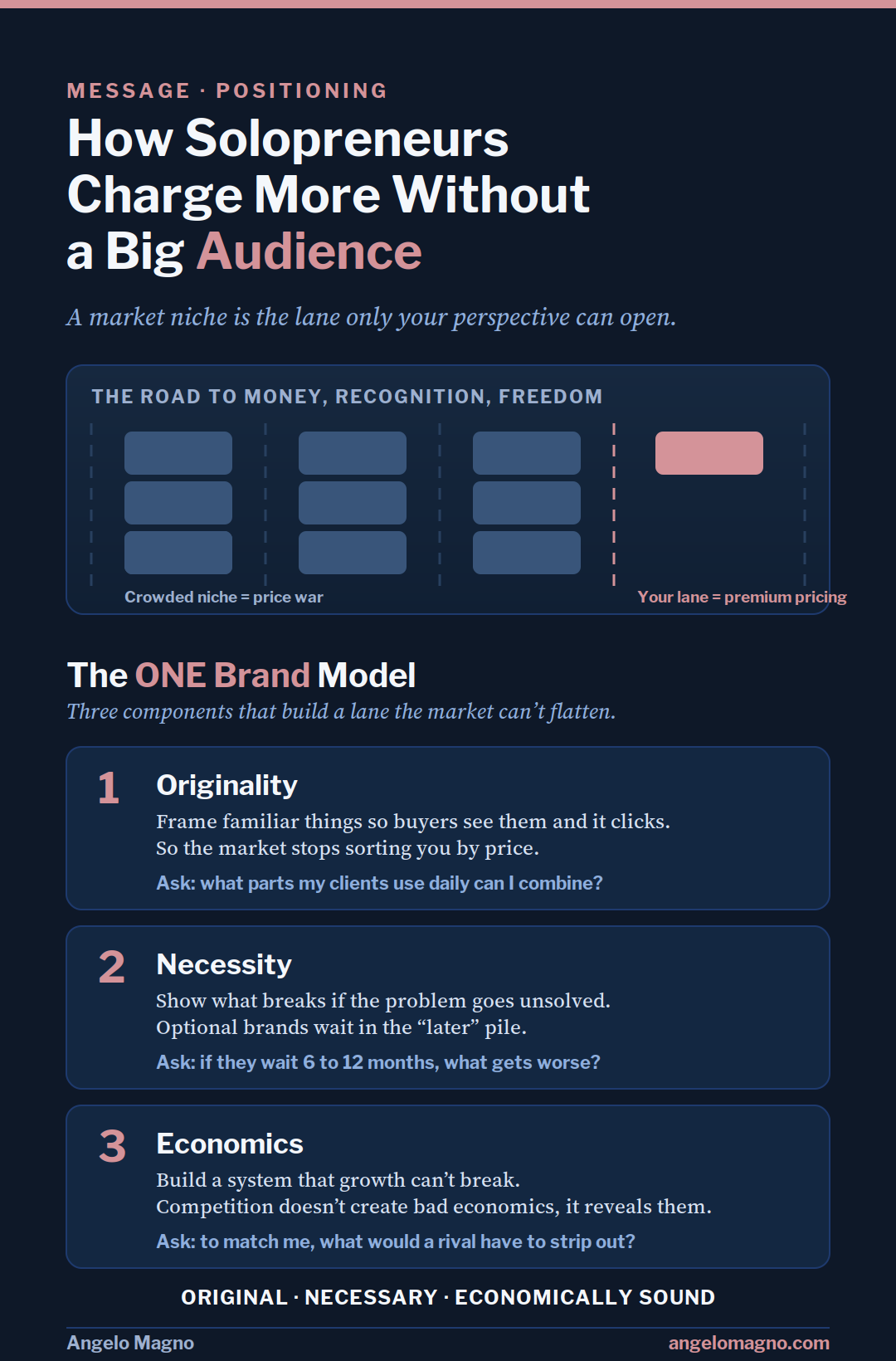
Picture the whole world of business as one long road toward money, recognition, and the freedom you started for.
Every lane on that road is a market niche.
The more brands crammed into a lane, the more saturated it gets, and the slower everyone in it moves.
When you launch, you enter at the far back of the road.
So you look up and ask the obvious question: which lane moves fastest?
Feels smart, right?
Find the quickest route, merge in, floor it.
Except the fastest lane on a road toward money would have to be an empty one.
And the only empty lane is a lane that does not exist yet.
Why Does Every Market Niche Feel So Crowded?
Watch what most new brands do the moment they go online.
They study what everyone else posts, note what performs, and copy the pattern a little better.
Scroll any feed in your space and it shows itself: same hooks, same thumbnails, same promises stacked lane on lane.
Proven, sure.
Also the longest traffic jam on the road.
The only empty lane on the road to money is the one nobody has built yet.
Can we blame anyone for it?
On the surface, following what works looks logical.
Look closer, though, and a trap appears.
Shape your product to fit a template, and the template starts shaping your product.
This is how commoditization begins, before you’ve sold a thing.
In Positioning: The Battle for Your Mind, Al Ries and Jack Trout explain why:
“The mind, as a defense against the volume of today’s communications, screens and rejects much of the information offered it.”
So the brands that break through stop adding noise. They change the shape of the thing instead.
What Is a Market Niche, Really? Positioning vs. Category
A market niche is a position in a market that a brand holds through its perspective, not a topic or category handed out by an algorithm.
We treat a niche like a theme.
A list of approved things we’re allowed to make so the market can box us and buyers can file us.
The promise is that the box makes clients line up.
But look at the brands that stand out.
They didn’t pick a category off a shelf.
They took whatever they kept thinking about, ran the world through it, and that lens became their lane.
A Nike hotel, you can picture. A Hilton shoe, you can’t.
They get so recognizable that they can change lanes and their audience follows.
- Picture a Nike hotel. You can, right?
- Now picture a Hilton shoe. Nothing shows up.
One brand built a perspective. The other built a category.
So the real question stops being “which market niche do I pick” and becomes “what could only come from me?”
How Do You Build Your Own Market Niche?
Here’s what I want to test with you.
There seems to be a repeatable base under brands that open their own lane and collect the pioneer’s reward: no traffic, premium pricing, a head start nobody can buy back.
Three components hold it up:
- Originality, so the market can’t flatten you into a spreadsheet.
- Necessity, so buyers stop filing you under “later.”
- Economics, so the whole thing holds once it starts working.
Stack them and you get what I’ve been calling the ONE Brand: Original, Necessary, Economically sound.
Originality: How to Escape Price Comparison
Originality is a technique for framing familiar things so buyers see them in a way that clicks, not a rare gift handed to a lucky few.
Here’s why it comes first.
When five brands offer something similar, buyers have the bandwidth to weigh each on meaning.
When a hundred brands offer it, meaning overloads and people reach for the easiest tiebreaker: price.
When a hundred brands look alike, buyers stop comparing meaning and start comparing price.
That’s commoditization in one move.
Feel like every other option, and you land on a spreadsheet sorted cheapest to priciest.
Your one path to getting picked becomes being the lowest number.
So how do you get original without inventing something nobody recognizes?
You don’t need a groundbreaking idea.
Think about the iPhone.
Steve Jobs didn’t invent the phone, the music player, or the internet communicator.
Every part existed the day he walked on stage.
The originality lived in seeing three products as one.
That’s the whole technique: take components your clients handle daily, then make them solve the same problem together.
Originality is noticing the connection everyone else steps over while they fight for room in the existing lanes.
Necessity: How to Make Buyers Choose Now
Necessity is the frame that turns an interesting brand into an urgent one by showing what breaks when the problem goes unsolved.
Say you nailed originality and you’re holding an iPhone-level offer.
Now you have to sell it, and originality creates interest, not urgency.
Interesting brands are the ones parked in the “maybe later” pile.
When something feels optional, watch how the mind slides:
- People delay it.
- Delay turns into second-guessing.
- Second-guessing turns into comparison.
- Comparison drops you back onto the price spreadsheet.
Nobody rushes to optimize what’s working. They rush to fix what’s breaking.
Nobody rushes to optimize what’s working.
They rush to fix what’s breaking.
An optional brand says, “here’s how we help you improve.”
A necessary brand says, “here’s what keeps costing you if this stays broken.”
So sit with this question about your own market niche: if your clients ignore the problem you solve for the next six to twelve months, what gets worse?
Say that out loud to your market, and the buyer stops asking whether you’re the best option.
They start asking what happens if they wait.
Originality gets you noticed.
Necessity gets you chosen.
Economics: Can Your Market Niche Survive Success?
Economics is how a business behaves after the sale, the structure that decides whether growth adds fuel or drains it.
Here’s the catch nobody warns you about.
Open a great lane and copycats show up.
Attention spikes, urgency surges, and a different problem walks in the door: can this hold?
You’ve seen the desperate version.
Brands always launching, always pitching, always discounting.
That looks like a marketing problem.
Underneath, it’s an economics problem.
Competition doesn’t create bad economics. It reveals the ones you already had.
When economics are broken, growth makes it worse.
More customers bring more support, more complexity, more cost.
If every new client has to be convinced from scratch and carried to value, scale multiplies stress instead of results.
A clean way to pressure-test yours: if a competitor tried to copy you, what would they have to strip out to match your price?
If the honest answer is “nothing,” you’re easy to replace.
If the answer is “they couldn’t without removing the value people pay for,” your lane holds.
Build the structure right and price wars stop making sense, because no one can match your value, price, and credibility at the same time.
The Signature Behind Brands That Last
Zoom out and the brands that become their own market niche keep running the same three moves.
Originality, so the market can’t flatten them into a spreadsheet.
Necessity, so buyers stop filing them under “later.”
Economics, so the whole thing holds once it starts working.
That’s the ONE Brand: Original, Necessary, Economically sound.
Less a framework you apply on a Monday, more the signature sitting under brands that outlast the lane they came from.
You don’t pick a market niche off the road.
You build the one nobody else knows how to drive in.
Inforgraphic
FAQ
What is a market niche?
A market niche is a position in a market a brand holds through its perspective, not a topic or category assigned from outside.
Most people treat it as a theme they’re allowed to work inside.
The brands that stand out treat it as a lens they run everything through, which is why their audience follows them even when they change what they make.
Do you need a big audience to charge premium prices?
No.
Premium pricing comes from being hard to compare, not from reach.
A large audience inside a crowded lane still competes on price like everyone else.
A smaller audience around a brand that reframes the problem pays more, because they feel you solve something no other option addresses.
How is a market niche different from a topic or category?
A topic is what you talk about.
A category is the box the market files you in.
A market niche, in the sense that protects pricing, is the perspective you run both through.
Two brands can share a topic and a category and still hold different niches, because the lens they see the problem through is what buyers remember and pay for.
What makes a brand feel necessary instead of optional?
Framing does.
An optional brand offers improvement, which buyers postpone whenever things feel fine.
A necessary brand shows the cost of leaving the problem unsolved, which buyers move on fast.
The shift runs from “here’s how we help you improve” to “here’s what keeps breaking if you don’t address this,” and it moves the buyer’s question from price to consequence.
Why do prices collapse in a saturated market niche?
Because buyers run out of bandwidth to compare on meaning.
With a handful of similar options, people weigh each on value.
With a hundred, comparison overloads and they fall back on the simplest tiebreaker: price.
Saturation pushes brands onto a spreadsheet sorted cheapest first, where the only lever left is being the lowest number.