Deciding what to do before you start a business is a personal design exercise that settles what the business must change, protect and cost in your life before you pick a model, niche or platform. It runs through eleven decisions, from what has to shift in your life to what you refuse to trade away.
What’s the next capability you need to build as a solopreneur?
Discover your solopreneur archetype
7 questions. Free. No email required.



When you say “I want to work for myself,” are you talking about work? Or are you trying to figure out whether you can take control of the next 20 years without blowing up the stability you spent the last 10 building?
What if the business model is the last thing you should be choosing?
Staying where you are can mean trading years for a life you already know you don’t want. Starting a business can mean discovering that freedom was a pretty word for a different set of obligations. Both outcomes are real, and the search for the right business model rarely protects you from either one.
So before the endless search for models, niches and platforms, I want to slow down and look at eleven decisions. They come from more than ten years of building businesses in different markets, for different clients, with plenty of failing and learning along the way. The goal is a clear picture of what founder life will ask of you, so it turns into the life you wanted and not a well-paid trap.
What should you decide before you start a business?
The usual advice about what to do before you start a business is tactical: register the company, test the idea, build an audience. Those steps matter, but they all assume you already know what the business is for. The first decision is what has to shift in your life for this business to be worth building.
Money is the easiest answer to picture, so it’s usually the first one. Try a sharper version of the question: would you rather double your income or stop working at noon? Those two answers point to very different businesses, with different hours, different customers and different ceilings.
Is money the goal, or the thing we reach for when we haven’t named the goal yet?
In my experience, money tends to behave like a short term need, not a long term goal. Once the pressure eases, the question underneath it comes back: what was the money supposed to change? Deciding that first gives every later decision something to be measured against.
What obligations does your business have to work around?
The second decision is about what your business has to respect, not what it can ask you to sacrifice. People often talk about starting a business as a test of how much you believe in yourself. For a lot of us, though, it isn’t an individual decision at all.
There may be a mortgage, kids or a partner. You may have spent a decade building a life that runs on predictable income, not a large one. So while the internet says “start a business and get rich,” the real question in your head is whether you can pay for your life for the next two years.
One person can quit tomorrow and absorb a year of failure. Another needs to build alongside a job for years. Same ambition, different obligations, and pretending they should make the same move has nothing to do with courage.
Would you still want the lifestyle on an ordinary Tuesday?
When we picture working for ourselves, we picture the exceptions: the trip, the random afternoon off, the month spent working somewhere beautiful. Most of founder life won’t be the exception. Most of it will be Tuesday.
We do this with everything we haven’t lived inside yet. You visit a city for a week, eat out every night, walk around beautiful places and think you could live there. Then you move, and it becomes weather, traffic and errands. The city didn’t lie to you; you judged it from the parts you were allowed to see.
What does a normal day look like when nobody is watching the highlights?
So the useful test is less exciting. When do you start and stop? Who gets access to your time? Does work stay at work, or does it sit in your head at dinner? If that ordinary day still beats what you have now, you’re comparing one life with another life, not one life with a fantasy.
Would you take the job your business creates?
The fourth decision asks you to be a little unfair to your idea. Take a business you already feel invested in, remove the founder title, and read it as a job description at somebody else’s company. Same work, but you don’t get to call it yours.
Ownership can make an idea look much cooler than it is. “I run my own business” sounds exciting, while the daily reality is selling, following up, fixing things and answering people so the thing keeps running. If you wouldn’t take that job from someone else, be careful about creating it for yourself.
Is a job more secure than a business?
The fifth decision is which your life needs more: predictability or security. They sound identical, and I’m not convinced they are. A paycheck that lands on the same day every month is predictable. If one company provides all of that income, a single decision you don’t control can remove all of it.
Now picture a business whose income moves around every month but comes from 20 different customers. It looks less predictable. Is it less secure, though? That distinction matters, because businesses tend to offer less predictability and more security, and people often turn them down for the wrong reason.
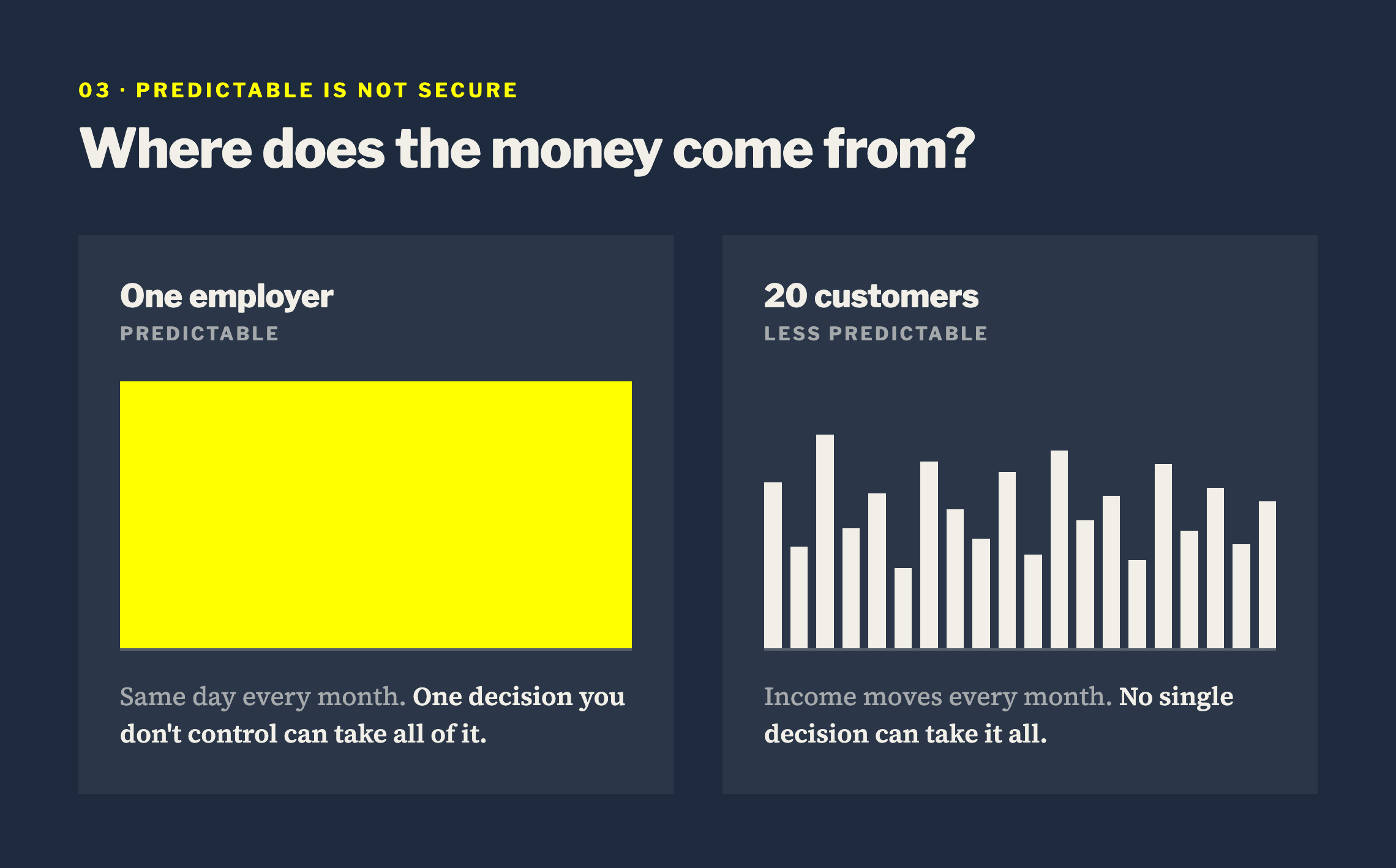
- Predictability is knowing when money arrives.
- Security is how many separate decisions would have to go wrong before it stops.
What are you willing to risk if you’re wrong?
The sixth decision isn’t only what you’re willing to lose; it’s what still has to be there if the business doesn’t work. “Burn the boats” sounds great in a 30 second video. But what’s on the boat? Your emergency fund, your house, your marriage, your ability to try again next year.
Failure is not a rare edge case here. The U.S. Small Business Administration’s Office of Advocacy reports that about 49.2 percent of new employer establishments survive five years. If the odds look like a coin toss, the structure of your downside deserves as much attention as your upside.
Does one business idea deserve the power to decide the rest of your life?
You’ll lose something if it fails: time, money, maybe some pride. That’s fine. Failing at a business and being unable to recover from it are two different things, and I’d rather choose an idea I can be wrong about without it taking everything else down with it.
Would you still want this business if it did nothing for your ego?
The seventh decision is the most uncomfortable one. Some businesses excite us for the life they could give us, and some excite us because of how they sound when someone asks what we do. “I built a software company” sounds cooler than “I sell a little digital product.”
If the boring business gives you the life you want, which one is the better business? This is where ego bends the decision: we choose what looks most like success over what feels most like success. Before falling in love with an idea, it helps to ask whether you want the business or want to be seen as the person who built it.
How do you know if a business idea will last?
The eighth decision asks whether you’re building around a need that lasts or catching a wave that happens to be high right now. Here is what haunts many new founders more than making no sales: making one and wondering whether it was luck.
Nobody wants to become the Gangnam Style of business, with one massive hit and no idea how to make the next one. That gap separates a salesperson from a founder. One wants the hit; the other wants to be in business ten years from now.
What problems will people still wake up with ten years from now?
The long run is unforgiving. The U.S. Bureau of Labor Statistics found that only 34.7 percent of business establishments born in 2013 were still operating in 2023. You can get the product and marketing right, work day and night, and still build a business with an expiration date you never controlled.
Should evidence choose your business, or test it?
The ninth decision is how you use evidence. You open YouTube, scroll, switch to Reddit, try a podcast, ask ChatGPT, and at some point it gets strange. The problem usually isn’t a lack of evidence; it’s asking evidence to do a job it can’t do.
Think of opening Google Maps without entering a destination. All the information is on the screen, and none of it can tell you where to go. Evidence can show whether a road leads to your destination, but it can’t choose the destination. Without that decision, more research just produces a more detailed map of everywhere.
Is being your own boss worth the uncertainty?
The tenth decision is how much uncertainty you’ll accept in exchange for control. The internet sells half the story: take control, be your own boss, own your time. I want that too. But when you take the steering wheel, what else comes with it?
In a job, someone else finds customers, absorbs the bad month and figures out payroll. Your paycheck can still arrive on Friday even if sales were terrible on Tuesday. Start a business and that uncertainty stops at no employer; it reaches your bank account, calendar, sleep and dinner table.
Maybe the trade is worth it. The point is that ownership doesn’t replace uncertainty with control; it hands you both. You can only make that trade honestly if you see the uncertainty that never makes it into a thumbnail.
What should you refuse to trade away for business growth?
The eleventh decision is what you won’t trade away even if the business rewards you for trading it. Red lines are easy to write before you start: family comes first, no sacrificing health, the business won’t take over my life.
Here’s the catch. The business won’t ask you to sacrifice your family; it will ask for a Saturday. It won’t ask for your health; it will ask for five hours of sleep. It won’t take over your life; it will ask you to check a dashboard during dinner.
- Each request is small and reasonable on its own.
- Each one feels temporary when you agree to it.
- Together they add up to the trade you swore you wouldn’t make.
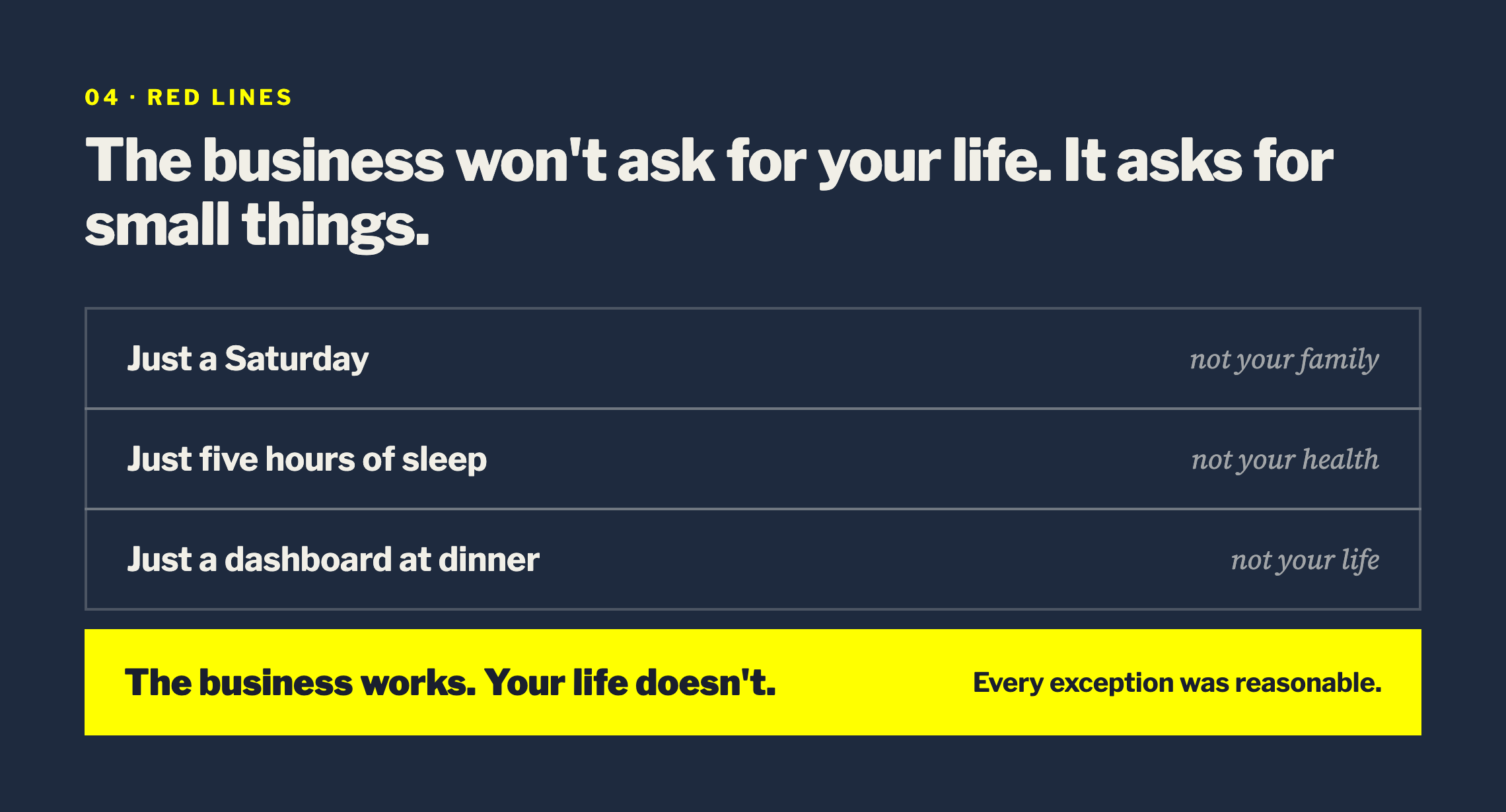
What if every exception is reasonable and the total isn’t?
That’s why red lines need to be defined as behaviors, not values. “Family comes first” survives any single Saturday. “No work on Saturdays” is something you can notice yourself breaking, before the business is working and your life isn’t.
What would make a business right for you?
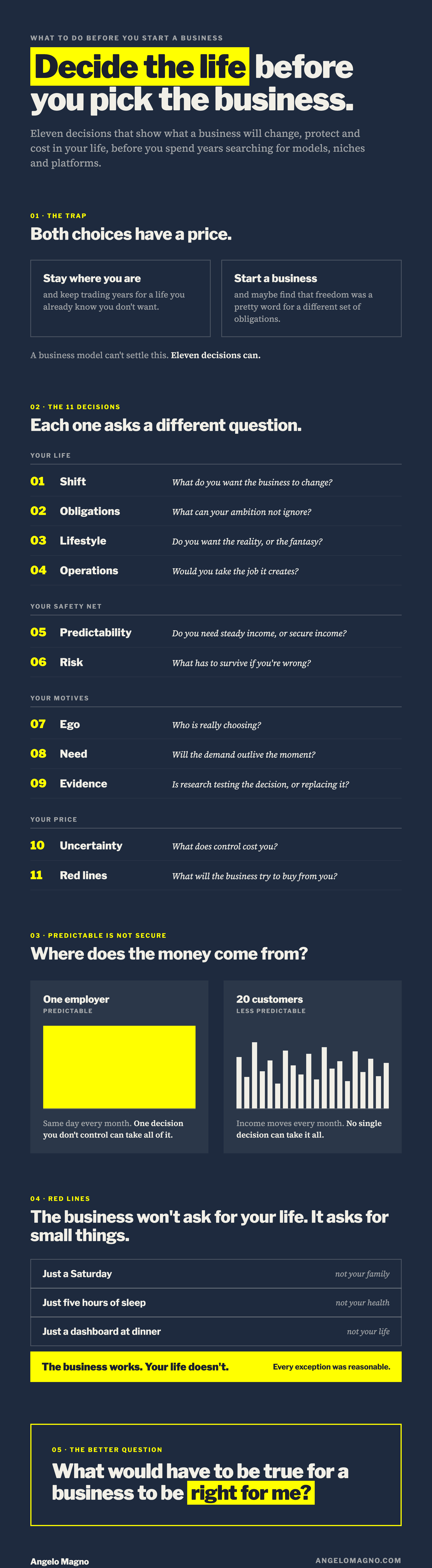
Put the eleven decisions side by side and they form a single instrument. Shift asks what you want to change, obligations ask what your ambition can’t ignore, and lifestyle asks whether you want the reality or the fantasy. Operations ask whether you want the job, and predictability breaks the security assumption.
Risk asks what has to survive if you’re wrong, ego asks who is choosing, and need asks whether demand outlives the moment. Evidence asks whether research is serving the decision or replacing it, uncertainty exposes the price of control, and red lines ask what the business will eventually try to buy from you.
Run any idea you feel invested in through them and watch where it starts fighting the life you said you wanted. Maybe the money looks great but Tuesday looks terrible. Maybe you love the work but the uncertainty would eat you alive, or ego is doing half the choosing.
The point is to make the trade-offs visible before you spend years inside an idea that is profitable, proven and impressive, yet wrong for your life. Then the search changes. You stop asking what the right business is and start asking what would have to be true for a business to be right for you.
Listen to the podcast
Infographic
FAQ
Do I need to answer all 11 decisions before starting?
No.
You need honest answers to the ones that could sink you, usually obligations, risk and red lines.
The others sharpen the choice between ideas.
Treat the list as a filter you return to, not an exam you pass once.
If an answer changes, that’s information, not failure.
Isn’t this just overthinking instead of starting?
It can be, if it replaces action.
These decisions take an afternoon, and they cost far less than spending two years building the wrong business.
The research loop in decision nine is the real overthinking risk: collecting evidence without choosing a destination.
Decide the destination, then move.
What if my obligations mean I can’t quit my job?
Then the business has to be built around the job, not instead of it.
That changes which models make sense: smaller scope, slower growth, work that fits evenings or weekends.
It isn’t a lesser path.
It’s the same ambition with a different set of constraints, which is what decision two is about.
How do I make predictability and security work together?
Many founders build the business while keeping a predictable income, then shift once revenue comes from enough separate customers to feel secure.
The aim is to never depend on a single decision you don’t control.
Track how many customers make up most of your revenue.
That number tells you more about security than any monthly total.
Next step
You’ve seen the 11 decisions. Which kind of business fits the way you work?
Discover your solopreneur archetype
7 questions. Free. No email required.