The decision-making RULE is a pre-commitment method that answers “should you quit your job to start a business?” by tying the move to one fact you can check instead of how you feel each morning. It has four parts: reduce the decision to one criterion, use an observable state, lock the outcome in advance and elevate the cost of reopening it.
What keeps you REOPENING the decision to quit?
Discover your solopreneur archetype


Free7 questionsNo email required

Some nights you go to bed sure that now is the time to quit and build your own thing. You wake up the next day and the confidence is not the same, so the job stays, the business stays on the side, and the question comes back a week later as if it had never been asked.
What if the decision isn’t failing for lack of information, but because it’s still open?
We tend to read that loop as a sign we need more data: one more podcast, one more spreadsheet, one more conversation with someone who already quit. I want to look at a different explanation. The decision keeps failing because it depends on a mood, and moods get repriced every morning.
So instead of asking “am I ready?”, this post works through one question: what would need to be true for this decision to stop depending on how I feel about it? The answer turns into a rule with four parts, and then we pressure test it against the objections that may have shown up in your head while reading this paragraph.
Should you quit your job to start a business, or is the question wrong?
Should you quit your job to start a business sounds like a yes or no question, and most advice treats it that way. One camp says burn the boats, because a safety net makes you soft. The other says keep the paycheck until the business replaces it. Both camps argue about the answer and skip the part that keeps people stuck: the answer keeps changing.
The research leans toward the cautious camp. Joseph Raffiee and Jie Feng at the University of Wisconsin-Madison followed people who started businesses and found that those who kept their day job were about a third less likely to fail than those who quit outright. The 9-to-5 isn’t the enemy. For many of us it is the runway.
But notice what that finding doesn’t settle. It tells you the hybrid path is safer on average; it doesn’t tell you when to leave it. Plenty of people keep the business on the side for years because they never closed the question of when it ends.
Is “keep it on the side” a plan, or a decision we keep postponing?
That is the distinction I care about here. A side business with an exit condition is a plan. A side business without one is the same open decision, renewed every Monday, and it costs attention every time it gets reopened.
Why does the decision keep coming back?
A decision that depends on how you feel tomorrow behaves like a mood with a deadline you keep moving. On a good night, the evidence looks strong. After a bad meeting or a short night of sleep, the same evidence looks reckless. Nothing in the situation changed; the person judging it did.
The default fix is more information, because information feels responsible. If we had the full picture, we tell ourselves, the decision would make itself. The trouble is that there is always more information, and each new piece gives the tired version of you another reason to reopen the file.
What is the decision-making RULE?
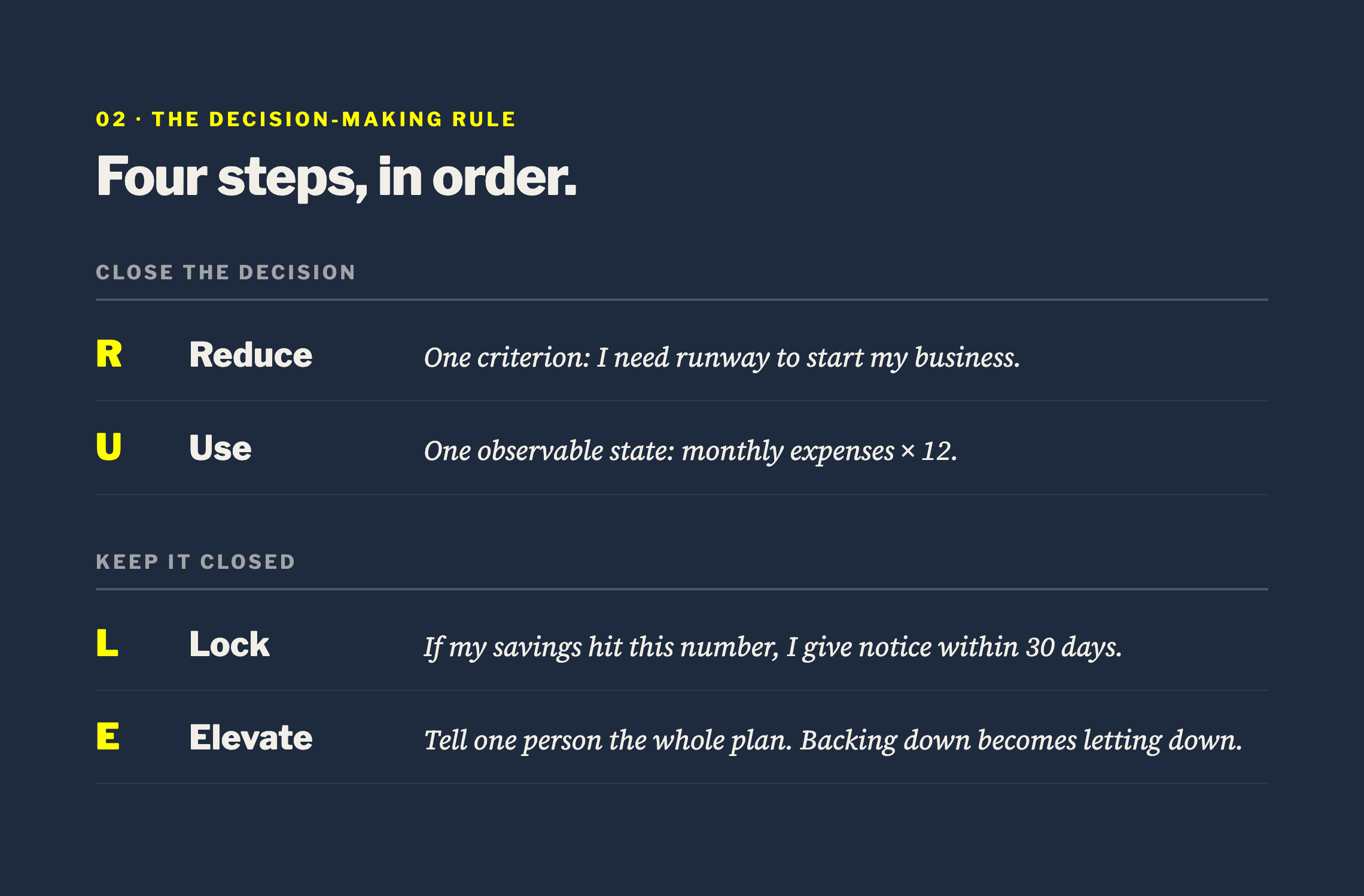
The decision-making RULE is a four-step structure that moves a decision out of daily negotiation and into a binding condition. Each letter answers one way the decision tends to fall apart, and the steps only work in order, because each one depends on the one before it.
- Reduce the decision to one criterion.
- Use an observable state that satisfies that criterion.
- Lock the outcome in advance.
- Elevate the cost of reopening the decision.
How do you reduce a decision to one criterion?
Quitting a job has a hundred variables: savings, family, the market, timing, fear. Weighing all of them sounds responsible, and that is exactly how the weighing never ends. Complexity is not the enemy; endless reconsideration is. At some point, complexity has to collapse into one thing that gets to decide.
For the person in the video, that one thing is runway. Starting the business means living without a salary for a while, so the criterion becomes: I need enough money to cover my life while the business grows. Other variables still exist, but they stop having a vote on the timing.
What counts as an observable state?
An observable state is a fact you can check without asking how you feel. So the criterion becomes a number: monthly expenses multiplied by twelve. The decision can be made when that number is true, not when you feel ready.
What changes when the question is “is it true?” instead of “do I feel it?”
“I think I’m ready” moves every morning. “My savings hit the number” only moves when you move it. That difference is the whole reason the second step exists: it gives new information a filter. New information only matters if it changes the state you tied the decision to. Everything else is noise, often very convincing noise.
Why lock the outcome before the day comes?
Most quit decisions die on the day the condition is met. The number is there, and there is a reason to wait one more quarter. So the third step decides the exact action while you are calm: if my savings hit this number, I give notice within 30 days.
This is close to what psychologists call an implementation intention, a plan in the form “if this happens, I will do that.” Peter Gollwitzer and Paschal Sheeran reviewed 94 independent tests of this kind of planning and found a medium to large effect on reaching goals (d = .65). The thinking happens once, in advance; the day itself only checks whether the condition applies.
How do you make reopening the decision expensive?
Between today and the day the number is true, doubt is going to show up like it always has. Instead of pretending this time will be different, the fourth step plans for that part. You tell one person you trust, someone you wouldn’t want to let down, the whole plan: the amount, the 30 days, the year it will likely take.
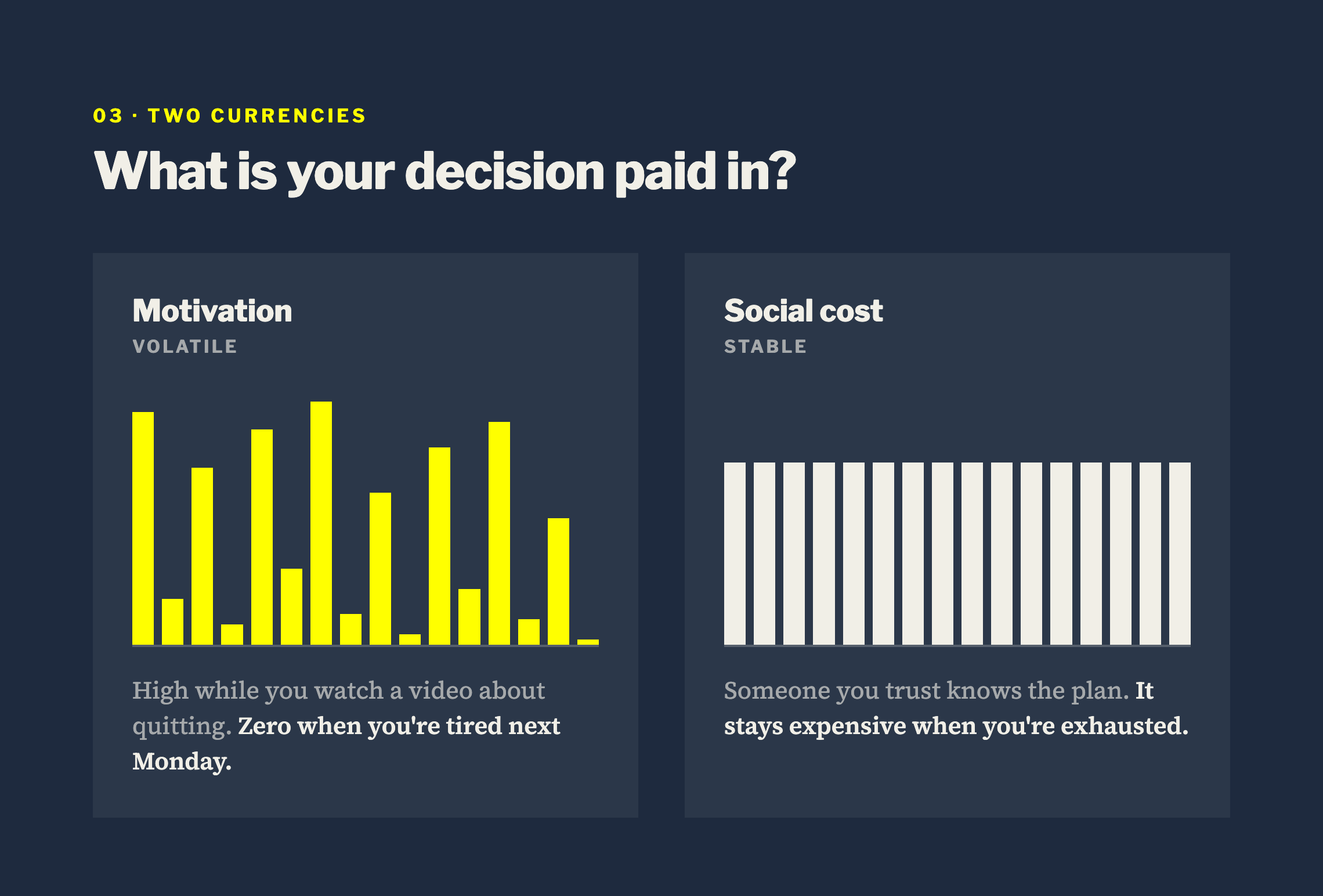
Backing down becomes letting down. We traded motivation for social cost, and that trade matters because the two currencies behave in opposite ways.
- Motivation is high while you watch a video about quitting and close to zero when you are tired next Monday.
- Social cost stays expensive when you are exhausted, which is when the decision needs protection.
There is evidence that stakes you set for yourself work this way. In a field experiment in the Philippines, smokers who were offered a commitment contract, putting their own money at risk on passing a nicotine test, were 3.3 to 5.8 percentage points more likely to pass than those who weren’t, and the effect held in surprise tests a year later. The money in that study and the friend in this rule do the same job.
What happens to doubt once the decision lives as a rule?
Doubt, fear and bad days don’t disappear. Most advice tries to make them go away, and they won’t. They just don’t get a vote anymore. The decision stopped living in your head and started living as a condition someone else knows about.
What if the goal was never to feel certain, but to stop needing to?
That is what I mean when I say the rule survives the version of us that shows up tired, distracted and doubtful. The daily question changes from “do I still feel like this is right?” to “does the condition apply?” The first question has a new answer every day; the second one only changes when the savings do.
Isn’t the decision-making RULE too simple for a decision this big?
If you are anything like me, objections started piling up a few sections ago. They deserve honest answers, because a rule that only works when nobody questions it isn’t much of a rule.
Aren’t you oversimplifying a complex decision?
Yes, on purpose. The variables don’t vanish; they get used once, to choose the criterion and the number, instead of being reweighed every week. If your situation has a second constraint that can’t be ignored, such as a partner’s income ending next year, that can shape the number. What it shouldn’t become is a second vote that reopens the timing.
What if new information shows up later?
There is always more information. A friend quits and posts about it, your company announces a reorg, someone launches a course that promises faster results. If your decision process requires the full picture, you’ve signed up for a lifetime of standing still. The filter from step two does the sorting: news that changes the number matters, and news that doesn’t is a distraction dressed as diligence.
Isn’t this emotionally unrealistic?
Exactly, which is why the rule doesn’t rely on emotional discipline at all. We’re terrible at self-enforced intentions, and pretty used to pre-committed rules: contracts, deadlines, exams. Nobody expects a student to feel like studying every night; the exam date does the holding. The RULE gives the decision to quit your job to start a business an exam date.
What if the criterion is wrong?
Then the mistake happens once, and that is the upgrade. Say you pick twelve months of runway and discover halfway through that the business needs fifteen. With a rule, the cost is finite and the learning is visible: you see the number was off, you correct it, you move.
Which is worse, a wrong number or a decision that never closes?
A wrong criterion can be corrected; an unclosed decision can’t be. An open decision produces no feedback at all, because nothing was ever tested. Years can pass with the same question and no new evidence, only new moods.
Doesn’t a rule reduce your freedom?
It does reduce one kind. You can’t keep every possible future alive and still make a decision. Freedom to reconsider is traded for freedom to move, and I think most people stuck on the quit question have plenty of the first and very little of the second.
What changes when your decisions stop being reopenable?
Think about life with reopenable decisions. You know the vibe: the same “I’ll think about it later,” a lot of mental activity, a lot of checking in with yourself, a lot of “am I still okay with this?” Each check costs attention the business needed.
With the rule applied, most of that work becomes one check: did the savings hit the number? Less thinking, more working. Motivation will still drop and bad days will still come; the difference is they won’t override the direction you chose for your life.
Which of your goals are hostage to your morning mood?
The question was never “why can’t I follow through?” A better one is: which of my goals are currently hostage to my morning mood? Quitting a job is the big example, but the same pattern runs through smaller decisions that keep getting renegotiated.
Look at your to-do list. If a task requires you to feel like doing it, it isn’t a plan; it’s a negotiation. Pick one, and apply the same four steps: one criterion, one observable state, the outcome locked in advance, a cost for reopening it.
This is where I land on the original question. Should you quit your job to start a business or keep it on the side? For most of us, keeping it on the side is the stronger starting position, as long as the side has an end date written as a condition. You don’t need more willpower; you need to stop giving the tired version of yourself a vote.
Listen to the podcast
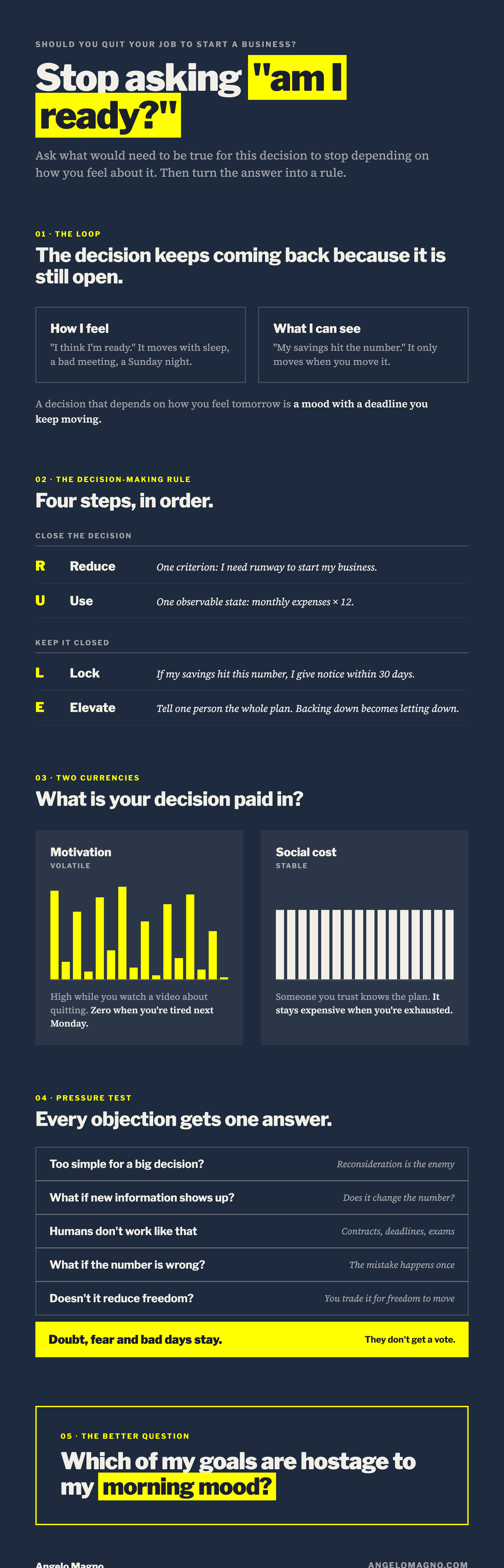
Infographic
FAQ
How much runway do I need before I quit my job?
A common starting point is twelve months of personal expenses, which is the number used in the video.
The right figure depends on how long your business needs to cover your costs and on obligations like a mortgage or dependents.
The RULE doesn’t pick the number for you.
It makes sure that once you pick it, the number decides instead of your mood.
Is it better to start a business while employed?
On average, yes.
Research by Raffiee and Feng found that people who kept their day job were about a third less likely to fail than those who quit outright.
The risk of the side path is that it never ends.
An exit condition, such as a savings number with a fixed notice period, turns the side business into a plan with a finish line.
Who should I tell about my plan?
Someone you trust and wouldn’t want to let down, who will remember the details.
A partner, a mentor or a close friend works.
Tell them the whole plan: the number, the action and the timeline.
A vague announcement like “I’m thinking about quitting” adds no cost to backing down, because there is nothing specific to back down from.
Can I use the decision-making RULE for things other than quitting?
Yes.
It works for any decision that keeps getting reopened: raising prices, ending a client relationship, launching a product.
Reduce it to one criterion, use a state you can observe, decide the action in advance and tell someone.
The quit decision is the hardest test, which is why it makes a good first example.
What if circumstances change in a way that matters?
Then the observable state changed, and the rule expects you to act on it.
Losing your job, a new dependent or a large unexpected expense can change the number.
What the rule filters out are changes in mood dressed as changes in circumstance.
Ask whether the news changes the number before letting it reopen the decision.
Next step
What keeps you REOPENING the decision to quit?
Discover your solopreneur archetype
Free7 questionsNo email required